Cargoos Sees Freight Verification Moving Beyond Carrier Vetting
Freight verification expands beyond carrier vetting to include customers, drivers, documents and transaction activity

Press Release Disclaimer: This is a press release distributed through the XPR Media network. It has not been independently verified by our newsroom.

Freight verification expands beyond carrier vetting to include customers, drivers, documents and transaction activity
CHICAGO, IL, UNITED STATES, August 27, 2026 /EINPresswire.com/ — Cargoos Logistics is expanding its approach to freight verification beyond traditional carrier and customer onboarding, with greater emphasis on verifying the participants, information and significant changes surrounding a freight transaction.
The approach builds on lessons Cargoos has shared following recent internal reviews of its customer onboarding practices.
Cargoos previously highlighted the importance of customer-side verification after inconsistencies surfaced during the review of a prospective commercial account. The company subsequently outlined a multi-layer verification approach in which customer information, authorized representatives, documentation, credit information and transaction details are considered together rather than relying on individual documents alone.
Cargoos says the next step is applying the same principle more broadly across the freight transaction.
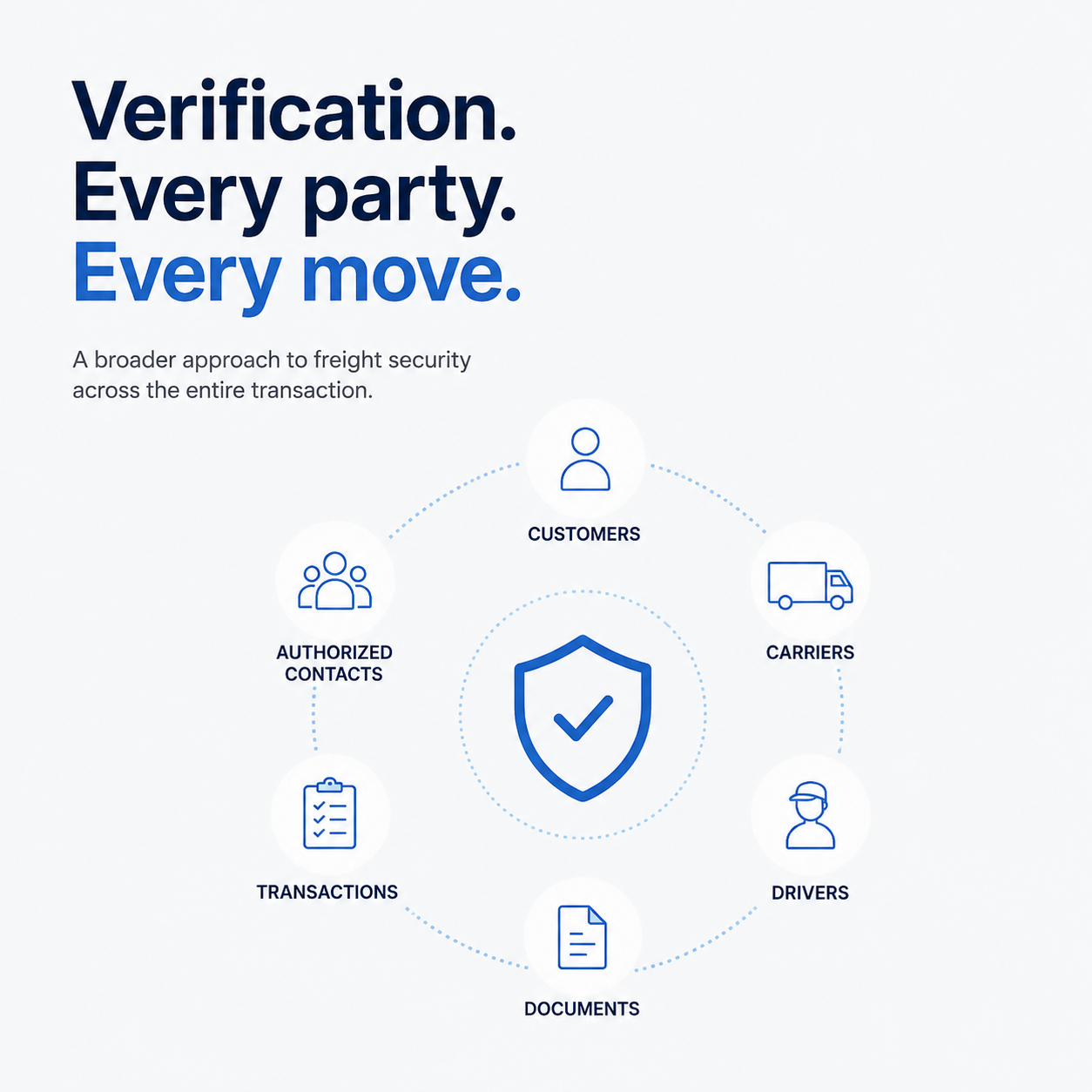
The company describes its developing approach as 360-degree verification — a framework that considers carriers, drivers, customers, authorized contacts, documents and material transaction changes as interconnected parts of freight risk management.
“Freight involves a network of connected parties, and information moves between all of them,” said Jaymie Freeman of Cargoos Logistics. “Verifying one participant is important, but it doesn’t necessarily tell you whether everything else in the transaction still makes sense.”
Multiple Participants, Multiple Verification Points
A typical freight transaction can involve a shipper, broker, carrier, dispatcher, driver, receiver and financial or administrative contacts.
Those participants can generate or exchange operating authority, insurance records, tax documentation, contact information, rate confirmations, pickup and delivery instructions, invoices and payment information.
Cargoos believes evaluating relevant information together can provide additional context when something changes unexpectedly.
A carrier, for example, may successfully complete an initial qualification process, but a significant last-minute change involving a driver, contact or shipment instruction may justify additional confirmation.
Similarly, a prospective customer may provide standard onboarding documentation while inconsistencies in contact information or authority to represent the business warrant further review.
The principle is the same one Cargoos has applied to customer verification: individual pieces of information can be useful, but their value increases when they are consistent with independently verified information elsewhere in the transaction.
From One-Time Checks to Ongoing Verification
Cargoos also sees verification as a process that can continue beyond initial onboarding.
Business relationships and operating information change over time. Employees leave organizations, carrier information is updated, payment instructions change and shipping patterns evolve.
Cargoos believes significant or unexpected changes can provide appropriate points for re-verification.
“An onboarding review tells you what was verified at that point in time,” Freeman said. “The next opportunity is recognizing when something has changed enough that confirming the new information makes sense.”
Cargoos has been refining internal procedures involving customer onboarding, carrier qualification and transaction review as part of this broader approach.
The objective, the company says, is not to add unnecessary steps to legitimate freight transactions, but to make verification more responsive to meaningful changes as freight moves from booking through delivery and payment.
Building Trust Through Better Information
The broader approach also connects with Cargoos’ ongoing technology development.
The company is exploring how verified operational information, historical performance and behavioral indicators could complement traditional freight records when evaluating transportation relationships.
As part of this work, an internal technology initiative currently in development is exploring ways to organize and evaluate operational and performance information to provide additional context around transportation reliability and risk.
The initiative remains under development and is part of Cargoos’ broader effort to examine how technology and verified information can support more informed freight decisions.
Cargoos says the longer-term objective is to support decision-making with information that reflects not only whether required documentation exists, but also whether verified information and operational behavior remain consistent over time.
“Verification and performance are different questions, but both contribute to trust,” Freeman said. “The more reliable information companies have throughout a transaction, the better positioned they are to make informed decisions.”
Artur Gronus
Cargoos Logistics
+1 312-772-4422
email us here
Visit us on social media:
LinkedIn
Facebook
X
Other
Legal Disclaimer:
EIN Presswire provides this news content “as is” without warranty of any kind. We do not accept any responsibility or liability
for the accuracy, content, images, videos, licenses, completeness, legality, or reliability of the information contained in this
article. If you have any complaints or copyright issues related to this article, kindly contact the author above.

Media gallery