The Founders Who Built Smart Glasses for Factories Are Now Building Ari OS, the OS You Talk To
Ari OS is launching today across RealWear smart glasses, iOS, Android, and the browser, with support for a growing

Press Release Disclaimer: This is a press release distributed through the XPR Media network. It has not been independently verified by our newsroom.


Vancouver, WA, Aug. 25, 2026 (GLOBE NEWSWIRE) — Ari is launching Ari OS, a conversational operating system for wearable AI that lets people operate their devices by speaking instead of tapping through apps and menus. Ari OS is available immediately on supported smart glasses from RealWear through the Apple App Store and Google Play, and in any browser at chat.ari-os.com. The company was founded in Bern, Switzerland by Timon Binder and Sebastian Beetschen, who previously built Almer’s smart glasses for factory and frontline workers. Their premise: the next interface will not be another screen full of apps. It will be a conversation.
Ari OS lets people interact with technology through natural speech instead of fixed commands, menus, and constant app switching. Users can ask questions, make calls, check messages, access information, create skills, connect services, and continue conversations across smart glasses, mobile, and the browser. The vision is to make AI feel less like a tool people open and more like an intelligent layer that moves with them.
Sebastian Beetschen, Co-founder of Ari, said: “People should not have to learn the language of technology. Technology should understand the way people already speak. Ari OS is designed for that shift. It brings voice, visual context, memory, and connected services into one experience that can follow you from your phone to your glasses and back again.”
Beyond a Voice Assistant
This is where Ari moves beyond a voice assistant. Ari is voice-first, but screen-smart. It answers out loud in short, clear responses, while showing rich visual cards when spoken words are not enough. A contact card, an email preview, a calendar list, a Teams conversation, a confirmation dialog, or a step-by-step guide can appear on screen at the exact moment the user needs it.
For consumers, this points to a more natural relationship with AI. Users do not need to stop, unlock a phone, open an app, search through menus, and type a prompt. They can speak, see, decide, and continue.
Timon Binder, Co-founder of Ari, added: “The best technology eventually disappears. With Ari, you shouldn’t have to think about which device to use, which app to open, which message to send, or which meeting to schedule. You should simply know what you want and say it. Ari takes care of the rest.“
One Platform, Five Connected Experiences
Ari OS is built around five connected experiences (Ari on Device, Ari Mobile, Ari Chat, Ari Cloud, and Ari Business) that together form one platform across three screens: glasses, phone, and browser. A conversation started on smart glasses can be reviewed later in the browser. A skill created in Ari Cloud becomes available on the device. A connector added once follows the user wherever Ari is used.
Ari on Device. On smart glasses, Ari runs hands-free and voice-first. A simple wake word starts a conversation, and Ari responds instantly with short spoken answers or a compact visual card on the display when a glance is faster than a sentence. Core functions keep working even with limited connectivity, so Ari stays useful on a factory floor, in the field, or anywhere a phone can’t be reached for.
Ari Mobile. The same assistant moves into the smartphone. Users can pair smart glasses, manage Wi-Fi, adjust brightness and volume, connect headphones, and sign devices into Ari Cloud, all while talking to Ari directly from the mobile app. The smartphone becomes both a companion app for glasses and a standalone Ari experience in its own right.
Ari Chat. In the browser or on mobile, users can ask Ari to read and triage emails, check calendars, summarize Microsoft Teams messages, find contacts, translate, calculate, answer questions, or guide them through a task. The same assistant runs across every surface, with the same account, history, and settings.
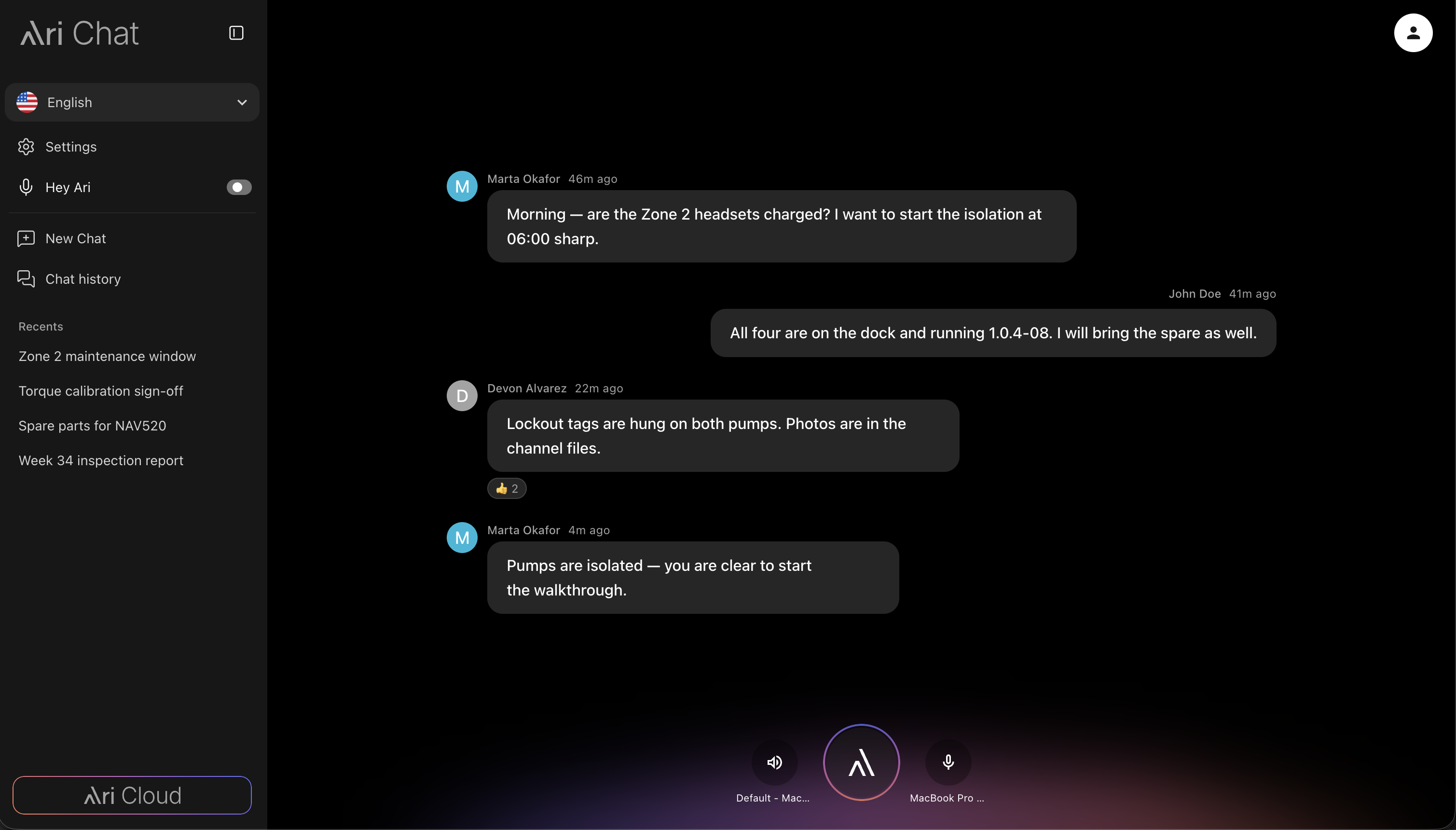
Ari Chat brings conversational AI to the browser, helping users access information, connect services, and get things done by voice.
Ari Cloud. Ari Cloud is the personal AI layer and control center behind the entire platform, accessible from any browser at cloud.ari-os.com. From there, users manage their chat history, skills, connectors, memory, documents, media, account, and subscription in one place. A built-in skill builder lets people create and edit custom skills that instantly sync to every device signed into their account, and a growing connector directory makes it possible to link services such as Outlook, Calendar, Contacts, and Teams with a single authorization. Ari Cloud also keeps every device in sync: a note taken on smart glasses, a document opened in the browser, and a reminder set on mobile all live in the same place. Memory is opt-in and fully user-controlled. Useful facts and preferences can be reviewed, edited, exported, or deleted at any time, so conversations get more personal without users losing visibility into what Ari remembers.
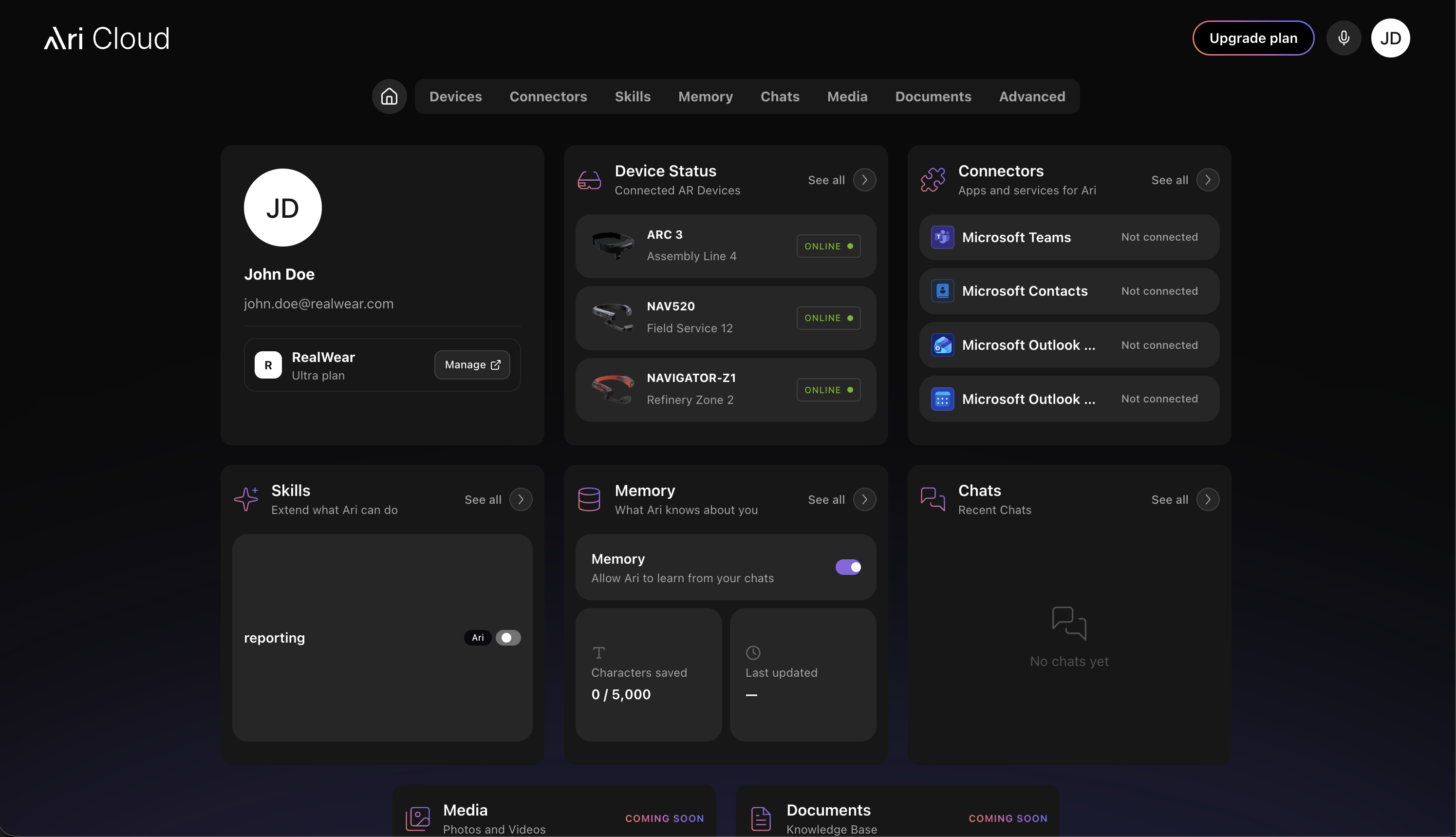
Ari Cloud is the personal AI control center connecting devices, skills, memory, chats, and media.
Ari Business. Ari Business extends the platform to organizations deploying wearable AI at scale, drawing directly on the founders’ experience equipping factories and frontline teams with smart glasses. It gives IT and operations teams a central admin console to manage fleets of devices, provision accounts, and roll out updates across an entire workforce. Teams can build and publish custom skills for their own workflows, such as checklists, machine manuals, inspection routines, or standard operating procedures, and distribute them instantly to every paired device. Ari Business connects to enterprise systems such as Microsoft Teams, SharePoint, and ticketing or ERP platforms, and supports single sign-on and centralized access controls so IT retains oversight of who can use what. Usage and adoption dashboards give managers visibility into how Ari is being used on the ground, while dedicated onboarding and support help organizations move from pilot to fleet-wide deployment.
Supported Devices
Ari OS supports a growing range of wearable devices, including smart glasses from RealWear, with mobile and browser access extending the experience beyond headsets.
An Ambient Future for AI
The broader idea is clear: AI should not stay trapped in chat windows. The next generation of AI will be ambient, wearable, personal, and available in the moment. It will help people while they move, work, travel, repair, learn, communicate, and create. Ari OS is built for that world.
Privacy and Control
Privacy and control are built into the platform. Users decide whether chat history is saved, whether Ari can remember information, and whether analytics are shared. Connected services such as Outlook, Calendar, Contacts, Teams, and custom connectors use secure authorization and can be disconnected at any time. For organizations using Ari Business, administrators can additionally set data-handling and retention policies at the fleet level.
Availability
Ari OS is available across supported smart glasses, mobile, and the web. Ari Chat is available at chat.ari-os.com, Ari Mobile through the Apple App Store and Google Play.
Media images can be found here.
About Ari
Ari is a conversational operating system for wearable AI. Built for smart glasses, mobile devices, and the web, Ari lets people interact with technology through natural speech, visual context, memory, skills, and connected services. From Ari Cloud, its personal AI control center, to Ari Business, its platform for enterprise and frontline deployments, Ari is designed to create a more natural interface for the next era of personal computing. Founded by former Almer founders Timon Binder and Sebastian Beetschen, Ari is building the next generation of human centered computing. For more information please visit www.ari-os.com

For further information please contact David Oreiro on david.oreiro@realwear.com