ASP Isotopes Issues Letter to Shareholders
DALLAS, Aug. 04, 2026 (GLOBE NEWSWIRE) -- ASP Isotopes Inc. (NASDAQ: ASPI) (“ASP Isotopes”, “ASPI” or the “Company”),

Press Release Disclaimer: This is a press release distributed through the XPR Media network. It has not been independently verified by our newsroom.
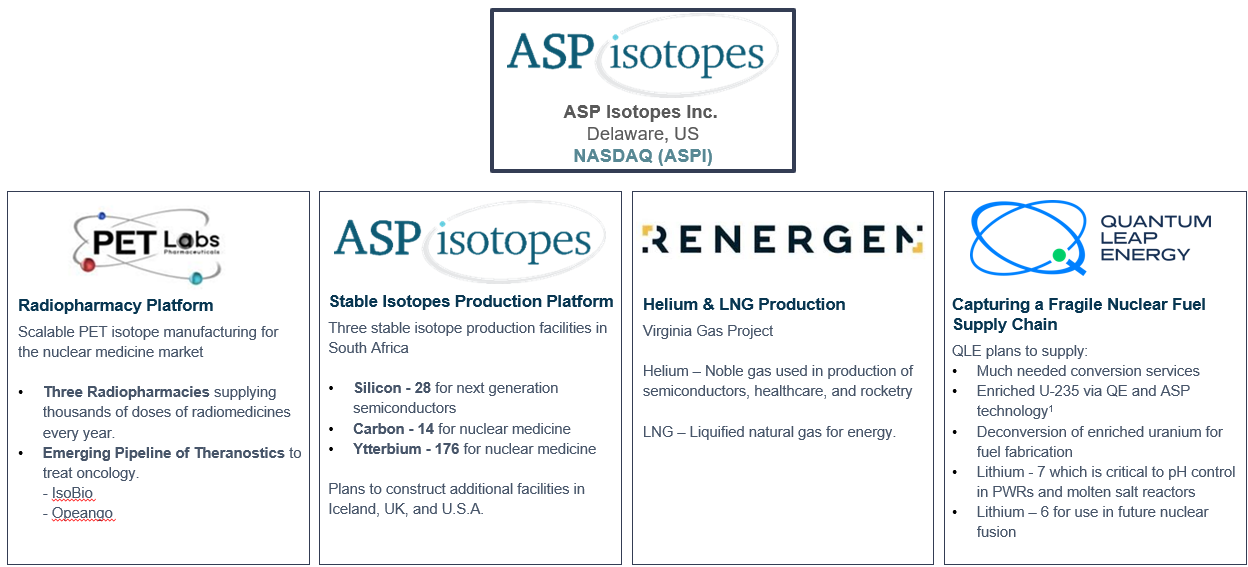

DALLAS, Aug. 04, 2026 (GLOBE NEWSWIRE) — ASP Isotopes Inc. (NASDAQ: ASPI) (“ASP Isotopes”, “ASPI” or the “Company”), an advanced materials company focused on developing technologies and processes for the production of critical materials used in multiple industries, today released the following letter to shareholders from its Executive Chairman and Chief Executive Officer, Paul Mann.
Dear Fellow Shareholder,
As we prepare to announce financial results for the second quarter of 2026, I wanted to take this opportunity to update you on the developments taking place at ASP Isotopes Inc.
All of our business units are making considerable progress, group revenues are increasing, and three of our business units appear at an inflection point and are expected to make substantial contributions to achieving profitability in the near term:
- During 1H 2026, our global PET Labs group demonstrated organic revenue growth of over 50% as compared to 1H 2025. We forecast that PET Labs is on track to deliver FY 2026 revenues of approximately $14 million, up from $6 million in 2025. We believe our projected growth is on track to deliver an annual $50-100m of EBITDA in 2031.1
- We expect to commence helium production at Renergen prior to September 30, 2026. At current expected prices, annualized forecasted helium and LNG revenues are expected to be approximately $27 million after the expected completion of Phase 1.2 In the current geopolitical environment where approximately 50% of global helium supply is estimated to be currently offline3, the world is desperately seeking an additional supplier of helium in a geopolitically neutral location, and we are prioritizing helium production to meet these demands.
- Our Silicon-28 and Ytterbium-176 enrichment facilities are in the final stages of commercial production, and we expect to ship initial product during 2H 2026. While the delays in our stable isotope division have been frustrating, these delays are attributable primarily to performance issues with certain equipment provided by our former OEM suppliers, not performance issues with our ASP technology. Our core enrichment technology continues to perform in line with our theoretical models, giving us strong confidence that these plants will deliver commercial product for industries with urgent need, including next-generation semiconductors and healthcare.
The two divisions that represent the powerhouse of the Company responsible for the majority of our near to mid-term EBITDA targets, namely PET Labs and Renergen, are operating ahead of our internal expectations both in terms of timing and potential profitability, reinforcing our confidence in our 2031 EBITDA target of greater than $300 million.4 We are currently negotiating helium and hydrocarbon supply contracts with potential large global customers on 5-15 years “take-or-pay” arrangements, which gives us considerable visibility over our expected future revenues.
Additionally, during 2H 2026:
- Renergen, through the planned reverse merger between Noble Africa LLC and ENDRA Life Sciences Inc. (Nasdaq: NDRA) (“ENDRA”), is expected to become a Nasdaq-listed company upon the closing of the reverse merger, allowing investors to invest in a commercial helium-focused company. ASPI will initially own approximately 89% of the combined company, after giving effect to the private placement financing that is expected to close immediately prior to completion of the reverse merger.
- Quantum Leap Energy (QLE), our nuclear fuels subsidiary, continues to pursue a public listing as a separate company. Having raised substantial amounts of capital between 2023 and 2026, we believe that QLE is well funded through its current development program and is expected to continue its momentum towards additional milestones, including commercial production of nuclear fuels. Following the recent exchange of certain QLE convertible notes held by third party investors for ASPI common stock, we hope to support our position to make a potential future distribution of QLE common stock to ASPI’s shareholders as of a to-be-determined future record date in a tax efficient manner.5
- Alpa Theranostics is a wholly owned biotechnology company established to develop technology that we have been incubating within ASP Isotopes for the last 24 months. Alpa Theranostics is expected to advance its first clinical candidates into human clinical trials during the next 12 months. We have observed efficacy in pre-clinical trials using novel nanobodies, which will be conjugated to a radioisotope produced by PET Labs.
Realizing the Sum-of-the-Parts
It is my intention to realize maximum shareholder value for all shareholders, including through taking steps to facilitate the appropriate valuation of the Company from a sum-of-the-parts perspective. We participate in multiple industries and end markets from nuclear fuels to nuclear medicine to electronic gases, all of which utilize isotopes. While all share a similar technological base, they each have very different dynamics and customers. Our medium-term strategy remains steadfast, to create a group that holds majority stakes in listed subsidiaries with complementary technologies. Our strong conviction driving this strategy is that listed subsidiaries with their own boards will result in an overall improvement in governance and autonomy.
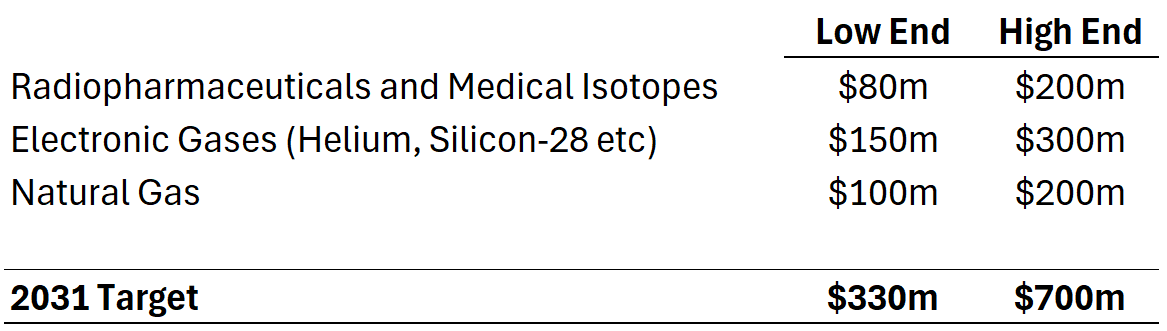
Long-Term Aspirational EBITDA Target6
As senior leadership, we have set ourselves strong but achievable goals, and we believe we are on track to deliver. Based on discussions with potential global helium customers, Renergen’s anticipated production of helium and LNG alone could potentially achieve the majority of our medium-term targets following the expected completion of Phase 2. We anticipate this projected EBITDA would be primarily secured on long-term (5-15 year), take-or-pay contracts. PET Labs is demonstrating tremendous organic growth and we are in the early innings of a new product cycle in nuclear medicine. Forecasting the growth in stable isotopes is more challenging as product cycles in semiconductors are of longer duration, however feedback from customers is that there is significant demand for new materials that can improve the efficiency of computing. The flip-side to longer duration product cycles is that once our products have been adopted into the production cycle, they may become a standard and necessary feature for a long time to come, aligning with our strategy of delivering long-term shareholder value.
Long-Term EBITDA Targets for Selected Commercial Products (excludes nuclear fuels):
London Investor Event – Sept 8, 2026
Coinciding with the World Nuclear Association Symposium in London (September 9-11, 2026), we have decided to host our first Capital Markets Day on September 8, 2026. Investors wishing to attend in person should contact sdighe@aspisotopes.com. There is limited capacity at the event and places will be allocated accordingly. However, the event will also be streamed so if you are unable to join in person then you can join online. During the event, participants will hear from several of our scientists and division leaders. We hope to see you there.
Division Updates
PET Labs and Medical Isotopes
The five years of investment in PET Labs is starting to show the results we anticipated. During 1H 2026, PET Labs achieved organic revenue growth of over 50%. Annualizing 1H 2026 results, PET labs would be on track to deliver FY 2026 revenues of over $14 million, up from $6 million in 2025. Globally, we now have four radiopharmacies which delivered tens of thousands of doses of radiopharmaceuticals during 1H 2026.
We are in the early innings of a new therapeutic product cycle whereby we harness radioisotopes to cure fatal diseases, such as cancer. There are currently only a handful of approved drugs, but there are hundreds in clinical trials, with many showing great promise. As these drugs become approved for clinical use, we expect that the world will require substantially more radioisotopes, and we are building the capacity to help supply these.
We are proud that in South Africa, PET Labs provides all treatments to children under 18 entirely free of charge, ensuring no child is denied access to critical care due to family financial constraints. We believe this initiative has generated immense goodwill in South Africa and strengthened the Company’s relationship with the government, enhancing its position as it pursues further growth opportunities both organically and through acquisitions.
Ytterbium-176 and Carbon-14
During 2H 2025, we suffered an outage at our Ytterbium-176 enrichment facility when a laser broke due to an unexpected power surge. This outage caused a considerable delay in enrichment activities. The facility recommenced enrichment during 1Q 2026 and has been successfully enriching Ytterbium-176 since. The team continues to work on improving laser beam dynamics and saturation while they await the delivery of a continuous processing vessel. During the first twelve months of operation, the ytterbium enrichment facility has been enriching ytterbium during three-hour enrichment campaigns approximately every two days. The continuous processing vessel is expected to allow the team to enrich continuously for approximately three months between shutdowns and thereby achieve commercial quantities. We expect the enhancements to the process will occur during 2H 2026.
The Company has entered into a multi-year take-or-pay contract with a Canadian customer for the supply of Carbon-14, an important isotope used in the development of new pharmaceuticals. Our Carbon-14 enrichment facility has been successfully enriching Carbon-12, while we await the Carbon-14 feedstock from our Canadian customer in quantities sufficient for commercial enrichment purposes. We expect to receive sufficient quantities of C-14 feedstock during 2H 2026, which will allow for commercial enrichment of Carbon-14.
Renergen
Operations and Phase 1
Since restarting operations in April 2025, following bridge loan funding provided by ASP Isotopes prior to the completion of the Renergen acquisition, Renergen’s Virginia Gas Project has advanced significantly across drilling execution, gas production and plant readiness. The drilling program for Phase 1 of the Virginia Gas Project has now reached the required cumulative flow rate required to operate the process plant at nameplate capacity, once tie-in connections are complete. We believe this milestone reduces execution risk for Phase 1, as the remaining activities to ramp up production to full capacity are now primarily engineering-oriented and pipeline construction tasks with fewer uncertainties.
The recent drilling success is primarily due to the post-restart engagement of a U.S.-based specialist in independent exploration, well design, drilling and reservoir modelling, to support more accurate and successful execution. This represents a departure from prior drilling approaches and has directly informed improved target selection and well design. Recent drilling successes have seen gas flow rates over 10 times those achieved in some of the earlier wells.
The plant continues to supply LNG to our existing customer base, maintaining deliveries alongside ramp-up activities. Progress on well completions and pipeline tie-ins is also continuing and remains on track to meet the production ramp-up timetable during 2H 2026.
Our ongoing safety performance remained a highlight in 1H 2026, with zero lost-time injuries recorded and 325 consecutive days without incident by the end of 2Q 2026. Our operations also continued to receive no directives from environmental regulators, reflecting our sustained commitment to safe, compliant operations and strong performance against both internal and external compliance requirements
Commercially, Renergen continues to build momentum in its offtake base. We recently secured an offtake agreement with an Asian industrial gases company for approximately 15% of planned Phase 1 helium production capacity volume at an initial base price per unit above US$600 per Mcf of contained helium, on an all-in plant-gate basis. We are in active negotiations with several prospective helium customers for the remaining Phase 1 volume and expect to finalize these arrangements shortly. However, given the continued depletion of global helium buffers (see below) we are being deliberate and strategic in the timing of any further commitments. We expect to secure long term (5-15 year) contracts for 50-75% of Phase 1 planned production capacity volumes. Assuming $15-18 per GJ (.9478 MMBtu) for our LNG shipments and an average of $600/Mcf for our liquid helium shipments, we believe Renergen should be capable of generating revenues of over $27 million on an annualized basis after the expected completion of Phase 1. We expect to begin recognizing these revenues during 2H 2026.
Growth: Phase 2 and the Helium Market
We expect to start the construction of Phase 2, at approximately 13 times the size of Phase 1, during 2H 2026, following completion of Phase 1. The construction of Phase 2 is expected to take approximately 44 months. We expect Phase 2 will benefit from approximately $750 million of senior debt funding from the U.S. International Development Finance Corporation and Standard Bank of South Africa, subject to entering into binding definitive agreements with these lenders. At nameplate capacity, Phase 2 is planned to be capable of producing approximately 34,000 GJ/day of hydrocarbons (likely LNG) and 900 Mcf/day of liquid helium, equivalent to 5-7% of the world’s helium supply.7 At $15-18/ GJ (.9478 MMBtu) for the hydrocarbons and $600/Mcf for the helium from Phase 2, Renergen should be capable of generating annual revenues exceeding $360 million at nameplate capacity. Phase 2 uses just 14% of our acreage, which leaves plenty of spare resource capacity for potential future Phase 3 and 4 construction projects, which we believe provides the Virginia Gas Project strong strategic positioning within the Free State helium basin.
The helium supply chain has been reshaped by geopolitics in recent years, and the effects are likely compounding rather than isolated. Qatar’s production, one of the world’s largest single sources, has been adversely impacted by war damage from the broader Iran conflict, with repairs expected to be measured in years rather than months. Russia has responded by tightening its own exports to protect domestic priorities. China, despite producing almost none of its own helium, has now restricted exports, most likely closing off the re-export channel it had quietly built. Meanwhile, America’s own federal helium reserve, the historical backstop, is tied up in legal receivership and effectively sidelined for the immediate future as a reliable supplier.
Based on discussions with prospective customers and industry participants, we understand that salt cavern storage has kept this issue from becoming an acute crisis. We believe there are only three such facilities in the world, and they have been drawn on heavily since March to keep semiconductor and medical customers supplied. These caverns have successfully absorbed the initial supply side shock, but we believe will likely be largely spent during the second half of the year, leaving a shortfall in supply. Industry reports now describe East Asian semiconductor makers’ emergency buffers as almost fully depleted.8 Accordingly, industrial gas companies have provided cautious expectations on helium recovery during 2H 2026.9 The uncomfortable implication is that if the caverns that have quietly absorbed the shock so far are now running dry, the visible disruption to date — price spikes, rationing, allocation battles — may only be the opening phase. The real helium crisis may still be in its early stages.
During our recent trip to Asia, we noted increasing concern among both governments as well as semiconductor fabricators, regarding the future availability of helium and the impact supply constraints may have on the industry. The direct contribution to GDP from the semiconductor industry in Taiwan, South Korea and Singapore is estimated to be approximately 20%, 10% and 7%, respectively.10 Based on discussions with market participants, spot prices for helium since the start of the Middle East conflict, to the extent relevant given the miniscule quantities transacted in this format, have risen from approximately $400/Mcf to over $2,000/mcf in some cases. With a significant imbalance between supply and demand emerging, it appears increasingly likely that certain end markets, such as diving, lifting and welding, may need to look for alternative materials.
Following our recent Phase 1 drilling success, Renergen is embarking on a full update of Tetra4’s geological resource estimate, the first comprehensive review since the independent assessment completed by Sproule in 2021. Since that report, the Company has accumulated substantial new subsurface data, including aeromagnetic, gravity and seismic surveys, together with results from recent drilling campaigns, which have contributed to the identification and confirmation of an additional reservoir body within the Karoo sandstone. This expanded dataset will underpin the updated resource assessment, which is expected to be completed during the fourth quarter of 2026.
Noble Africa
In June, we announced the proposed merger of Noble Africa LLC (“Noble Africa”), a subsidiary we formed to be the intermediate holding company for Renergen, with a subsidiary of ENDRA. In connection with the merger, the combined company is expected to be renamed Noble Africa Inc. and to have shares of its Class A common stock listed under the ticker symbol “NOBA” on The Nasdaq Stock Market LLC. In addition, in connection with the merger, we secured commitments for a private placement into Noble Africa for gross proceeds of approximately $50 million, including approximately $20 million from ASP Isotopes, as the lead investor, and approximately $30 million from other investors, including $750,000 from certain directors and management of ASP Isotopes to accelerate Phase 2 of Renergen’s Virginia Gas Project. If the transactions are completed, ASP Isotopes will own approximately 89% of Noble Africa with a free float of approximately 11%. We expect Noble Africa to be the only Nasdaq-listed company focused on helium production. We expect the transactions to close during 2H 2026, subject to customary closing conditions.
Electronic Gases
Silicon-28
The Company shipped its first samples of enriched Silicon-28 to a U.S. customer in August 2025, and independent analysis confirmed that enrichment levels tracked in line with theoretical calculations. Whilst considerable time has passed between this initial shipment and where we find ourselves today, the Company has begun implementation of numerous modifications to non-core elements of the Silicon-28 enrichment facility, such as valves, compressors and piping, which were successful in their effect. The final engineering challenge has been upgrading the compressors within the facility. The compressors, originally ordered by Klydon eight years ago prior to our acquisition, have failed to meet the specifications required including being hermetically sealed (helium tight). As leadership, we fully acknowledge the delays, and we are as frustrated as the rest of the shareholders, and are committed to implementing meaningful solutions to resolve these remaining issues standing in the way of commencement of commercial deliveries.
Our engineering team has upgraded over 200 OEM supplied compressors so that they can perform in line with the tight specifications. The Silicon-28 enrichment facility is now operating with 48 stages in cascade and has enriched significant quantities of Silicon-28 to 98% enrichment versus a natural abundance of 92%. We aim to ship our first batch of finished product at 99% enrichment during 2H 2026. We view the potential market size for Silicon-28 enriched to 99% abundance as substantially larger than the market for higher levels of enrichment, therefore starting product supply at this level of enrichment is an important milestone for the Company. The engineering team is currently in the process of upgrading the remaining compressors, a painstaking process, but without additional enrichment stages, the plant will not be capable of enriching Silicon-28 to 99.995%, which is required, albeit in small but high-value volumes, for quantum computing. We are in the process of upgrading compressors in the additional stages to allow for such enrichment.
As Stefano Marani, President of ASP Isotopes’ Electronics and Space division describes it, “The key distinguishing feature of 99% versus 99.995% is the use case; quantum computing requires “noise” suppression, semiconductors need heat dissipation. In a quiet room even the smallest noise can be heard, so purity is critical. Thermal conductivity improves even with small gains.”
The Company has previously announced that it has signed three commercial contracts for enriched Silicon-28 with U.S.-based customers requiring it for quantum computing and next generation semiconductors. The Company expects to make initial commercial shipments of enriched Silicon-28 during 2H 2026.
Carbon-12 and Carbon-Based Materials
Carbon, arranged as diamond, already conducts heat better than metal — which is why it’s used as a heat spreader in power chips and the RF amplifiers behind 5G and 6G. Isotopic purification lifts that conductivity a further 40–50%, a gain that carries through to graphene (10x copper) and points to carbon nanotubes as the next frontier for both semiconductors and quantum computing. Our Carbon-14 plant has been successfully enriching Carbon-12 this year, while we await the feedstock required for Carbon-14, and we expect to ship our first samples of Carbon-12 during H2 2026.
“Engineers have achieved near-on miracles in reducing microchip components to nano-scale structures, but eventually atoms become your limiting factor. Now it is time for the particle physicists to lead the way forward in creating materials that will advance technology, and with our isotopic separation technology we are ready to step up and play our part,” said Stefano Marani, President of ASP Isotopes’ Electronics and Space division.
Quantum Leap Energy
Under the leadership of Dr. Ryno Pretorius, Quantum Leap Energy LLC (QLE), which is dedicated to advancing innovative technologies and processes across critical segments of the fission and fusion nuclear fuel cycle, continues to make great progress. QLE continues to pursue a public listing on a U.S. national securities exchange as a standalone company, and ASPI continues to plan for a potential future distribution of its QLE common equity to ASPI’s stockholders as of a to-be-determined future record date. We believe that during the last three years QLE has successfully raised sufficient capital to achieve many major milestones, including the initial commercialization of nuclear fuel enrichment.
Recently, we exchanged approximately 50% of the outstanding QLE convertible notes for ASPI common stock, reducing the aggregate principal amount of QLE convertible notes held by third party investors to approximately $79.1 million. Following these exchange transactions, ASP Isotopes holds approximately $140.7 million aggregate principal amount of QLE convertible notes and 100% of the QLE common equity (excluding outstanding RSUs that are subject to vesting conditions). We structured the exchange transactions to be broadly economically neutral to both ASPI shareholders and QLE noteholders. As a result of the exchange transactions, following the conversion of the outstanding QLE convertible notes into QLE common equity pursuant to their terms upon completion of a QLE listing transaction, ASP Isotopes is expected to own well in excess of 50% of QLE’s common equity, which may support our position to make a potential future distribution of QLE common stock to ASPI’s shareholders as of a to-be-determined future record date in a tax efficient manner.11 Without completing the exchange transactions it would have been more challenging for ASP Isotopes to distribute its QLE common stock to ASPI shareholders in a tax efficient manner.
Regional Operational Updates
South Africa: In February 2026, QLE and the South African Nuclear Energy Corporation (“Necsa”) executed a Pre-Implementation Services Contract Agreement (“Services Contract”) as part of the planned collaboration on the research, development and ultimately commercial production of High Assay Low Enriched Uranium (HALEU), marking a critical step forward in addressing global nuclear fuel supply needs for next generation fission reactors.
Necsa’s mandate and expertise is in nuclear research and technology innovation and Necsa is among the world’s leaders in nuclear technologies. The Services Contract builds on the previously announced MOU between ASPI’s South African subsidiary and Necsa, and leverages QLE’s enrichment capabilities alongside Necsa’s world-class capabilities and strategic positioning in the global nuclear value chain.
In South Africa, since the formal commencement of activities, QLE has secured non-proliferation registration, entered into a comprehensive partnership framework with Necsa, obtained formal site and facility allocation, advanced project safety and governance processes, completed independent technical and facility readiness assessments, and received an authorization covering source material and nuclear-related equipment and technology for enrichment-related activities, with the initial authorization for cold commissioning of the uranium enrichment test-bench facility.
Authorization from the South African governmental authorities represents an important milestone for civilian nuclear enrichment activities in South Africa. Civilian enrichment authorizations of this nature have not been granted in South Africa for multiple decades, making this a significant development in the country’s civilian nuclear fuel cycle programme.
United Kingdom: QLE’s United Kingdom activities are focused on advancing quantum enrichment technology, initially for lithium, through its announced partnership with the University of Bristol. This collaboration gives QLE access to deep academic and technical expertise in materials handling and related scientific disciplines, and supports QLE’s efforts to develop and de-risk a UK-based pathway for lithium isotope enrichment.
United States: QLE’s United States activities are focused on developing the domestic platform required to support advanced nuclear fuel-cycle capabilities, including lithium isotope enrichment, uranium conversion, potential uranium enrichment and related deconversion activities. The U.S. program is being advanced through a combination of site development, customer and strategic-partner engagement, equipment procurement, regulatory engagement, technical hiring and external advisory support.
In March 2026, QLE entered into a non-binding Memorandum of Understanding with a large publicly traded U.S. energy company that operates nuclear power stations. Under the MOU, the U.S. energy company will evaluate options to support QLE’s plans to establish advanced nuclear fuel-cycle facilities in the United States, including facilities planned to produce HALEU and LEU+, as well as provide uranium conversion and deconversion services. The MOU outlines potential terms for financial support pursuant to definitive agreements for the supply of enriched uranium.
QLE is also translating its U.S. development pathway for QE technology into physical equipment and system requirements. QLE has completed initial specifications for laser systems required for lithium enrichment, entered into purchase arrangements for a number of components, and anticipates receiving relevant equipment later this year. QLE has also developed initial models expected to support future plant-design work. These models are expected to be validated and refined using the systems now being procured.
QLE is also advancing U.S. conversion capability. In July 2026, QLE signed a research agreement with the Texas A&M Engineering Experiment Station to advance and de-risk the commercial production of high-purity uranium hexafluoride (UF6), a critical feedstock in the nuclear fuel enrichment supply-chain. The agreement focuses on collecting fundamental physicochemical data on the reactions involved in producing uranium hexafluoride from yellowcake uranium. QLE has also completed an initial Front-End Loading (FEL-1) study for a conversion facility design in the U.S. and expects to continue refining the design and supporting techno-economic analysis over time.
Regulatory engagement is also underway in the U.S. through a structured program with relevant authorities and strategic stakeholders. These discussions are intended to help QLE evaluate available development pathways, including potential research-scale demonstration activities, and to align its U.S. development planning with applicable regulatory, safety, security, safeguards and environmental requirements.
QLE has also formed a U.S. Advisory Board to support the company’s U.S. strategy and execution. The advisory group includes highly credentialed leaders and technical experts with relevant experience across the nuclear fuel cycle, policy, regulation, commercialization and strategic partnerships, including Dr. Mary Lou Dunzik-Gougar, Dr. Peter Fiske and Kevin Kramer. This board is expected to augment QLE’s existing team as it advances U.S.-based fuel cycle activities and stakeholder engagement.
Market Opportunity
QLE is innovating at a critical time as advanced reactor technologies requiring HALEU fuel are being developed globally at an accelerating pace to meet the clean, baseload power demands of AI data centre infrastructure and industrial electrification. HALEU is a crucial fuel for many small modular reactors (SMRs) designs and other advanced nuclear reactor designs. The United States Department of Energy estimates that by 2035, the country will need 50 metric tons per year of HALEU to support its commercial nuclear power industry, escalating to 500 metric tons per year by 2050.
QLE focuses on both front-end activities, including uranium conversion, enrichment of uranium-235 for nuclear fuel production (HALEU, LEU+ and LEU), and isotopic separation of lithium-6 and lithium-7, as well as back-end radioactive waste treatment technologies.
Alpa Theranostics
Pipeline and approach
During the past two years we have engaged in the development of a pipeline of nanobody-powered targeted radionuclide therapeutic candidates and we expect the first of these to enter human clinical trials during the next 12 months with initial results anticipated during 1H 2027.
Radionuclides and target diseases
Our work suggests that Nanobodies will play a significant role in the radionuclide-based cancer imaging and therapy in the future, and there are strong signals of rapid development and commercialization of this treatment modality. In our opinion, the short biological half-life of Nanobodies makes them the best tracer for carrying short-lived radionuclides and owing to their small size, Nanobodies also have a higher solid tumor penetration than monoclonal antibodies (mAb), which have traditionally been used to deliver radionuclides. Numerous studies have suggested that unlike mAb, fragments and peptides, Nanobodies usually recognize hidden, cryptic and inaccessible epitopes in the antigen, they do not compete with regular antibodies for binding to antigens. Although they are much larger than Blood Brain Barrier (BBB) free diffusion limit of 400 Da, they have been shown to transmigrate across the BBB which is an important characteristic for tumours as well as brain metastasis.
We expect to use Terbium-161 and Actinium-225 as the radionuclides in our therapeutic candidates. Terbium-161 is a promising candidate for clinical translation because it emits short-ranged conversion and Auger electrons in addition to β¯-particles and γ-radiation, which may effectively eliminate microscopic metastases that are not even visible on a PET image but are responsible for relapse and metastatic spread.
We have multiple Nanobodies in development and while some of our research programs are focused on tumor types such as gliomas, colorectal cancer and triple negative and Her-2 positive breast cancer we also intend to develop therapeutic candidates for cancers that affect the younger population where there are currently no approved therapies, such as triple negative breast cancer and osteosarcoma. The successful development of treatments for these diseases would represent a significant scientific breakthrough, improving the survival outcomes for thousands of young people annually.
Leadership
Our research efforts at Alpa Theranostics are expected to be led by Martin Magwaza in partnership with NuMeRi under the leadership of Prof Mike Sathekge. Martin is a Biotech entrepreneur with a particular focus on Medical Biotechnology and Cancer Theranostics. He has undergraduate training in Biotechnology and Applied Science from the University of KwaZulu-Natal, South Africa and received postgraduate training in Geoinformatics at NMMU, Pharmaceutical Marketing at the Chartered Institute of Marketing (Cookham, UK). After a successful career with several Multinational Pharmaceutical Corporations, Martin pursued an entrepreneurial career in Biotechnology and founded several businesses and developed biotech products. Mike Sathekge is Professor and Head of the Nuclear Medicine department at the University of Pretoria and Steve Biko Academic Hospital. He also heads the South African Nuclear Medicine Research Infrastructure (NuMeRI). Mike is a clinical innovator and researcher with a significant track record in developing Theranostics based on Lutetium 177, Actinium 225, Rhenium 188 (and many others).
If you would like to learn more about the Company, please visit our corporate website and make sure to follow us on our social media channels.
Thank you for your continued interest and support.

Paul E. Mann
Executive Chairman and Chief Executive Officer
About ASP Isotopes Inc.
ASP Isotopes is developing a differentiated isotope enrichment platform to strengthen global supply chain access to critical materials used in nuclear medicine, next-generation semiconductors, and nuclear energy. The Company’s proprietary technologies, the Aerodynamic Separation Process (“ASP technology”) and Quantum Enrichment (“QE technology”), are designed to enable the production of isotopes for a range of industrial and advanced technology applications. ASP Isotopes operates isotope enrichment facilities in Pretoria, South Africa, focused on the enrichment of low atomic mass elements, or light isotopes. For more information, please visit www.aspisotopes.com.
About Renergen
Renergen Limited, a subsidiary of ASP Isotopes Inc., is a company incorporated under the laws of the Republic of South Africa whose principal asset is its 94.5% equity ownership in Tetra4 Proprietary Limited. Tetra4 Proprietary Limited holds an onshore petroleum production right and engages in the production and liquefaction of natural gas and the exploration and development of helium resources at the Virginia Gas Plant located in Free State Province, South Africa.
Important Additional Information and Where to Find It
This communication relates to the proposed reverse merger involving ENDRA, ASP Isotopes, Renergen and Noble Africa and may be deemed to be solicitation material in respect of the proposed reverse merger. In connection with the proposed reverse merger, ENDRA intends to file relevant materials with the SEC, including a registration statement on Form S-4 (the “Form S-4”) that will contain a proxy statement (the “Proxy Statement”) and prospectus. This communication is not a substitute for the Form S-4, the Proxy Statement or for any other document that ENDRA may file with the SEC and/or send to its stockholders in connection with the proposed reverse merger. INVESTORS AND STOCKHOLDERS OF ENDRA ARE URGED TO READ THE FORM S-4, THE PROXY STATEMENT AND ANY OTHER RELEVANT DOCUMENTS THAT MAY BE FILED WITH THE SEC, AS WELL AS ANY AMENDMENTS OR SUPPLEMENTS TO THESE DOCUMENTS, CAREFULLY AND IN THEIR ENTIRETY IF AND WHEN THEY BECOME AVAILABLE BECAUSE THEY WILL CONTAIN IMPORTANT INFORMATION ABOUT ENDRA, ASP ISOTOPES, RENERGEN, NOBLE AFRICA, THE PROPOSED REVERSE MERGER AND RELATED MATTERS.
Investors and stockholders will be able to obtain free copies of the Form S-4, the Proxy Statement and other documents filed by ENDRA and ASP Isotopes with the SEC (when they become available) through the website maintained by the SEC at www.sec.gov. ENDRA’S Internet website address is www.endrainc.com. ENDRA’s Annual Report on Form 10-K, Quarterly Reports on Form 10-Q, Current Reports on Form 8-K, including exhibits, and amendments to those reports filed or furnished pursuant to Section 13(a) or 15(d) of the Exchange Act are available free of charge through the investor relations page of its Internet website as soon as reasonably practicable after it electronically files such material with, or furnishes such material to, the SEC.
Participants in the Solicitation
ENDRA, ASP Isotopes, Renergen, Noble Africa, and their respective directors and managers and certain of their executive officers and other members of management may be deemed to be participants in the solicitation of proxies from ENDRA’s stockholders in connection with the proposed reverse merger under the rules of the SEC. Information about ENDRA’s directors and executive officers, including a description of their interests in ENDRA, is included in ENDRA’s most recent Annual Report on Form 10-K for the year ended December 31, 2025. Information about ASP Isotopes’ directors and executive officers, including a description of their interests in ASP Isotopes, is included in ASP Isotopes’ most recent Annual Report on Form 10-K for the year ended December 31, 2025. Additional information regarding the persons who may be deemed participants in the proxy solicitations, including the directors and executive officers of Renergen, and a description of their direct and indirect interests, by security holdings or otherwise, will also be included in the Form S-4, the Proxy Statement and other relevant materials to be filed with the SEC when they become available. These documents can be obtained free of charge from the sources indicated above.
No Offer or Solicitation
This press release is not intended to and does not constitute a solicitation of a proxy, consent or approval with respect to any securities or in respect of the proposed reverse merger or an offer to sell or the solicitation of an offer to subscribe for or buy or an invitation to purchase or subscribe for any securities pursuant to the proposed reverse merger or otherwise, nor shall there be any sale, issuance or transfer of securities in any jurisdiction in contravention of applicable law. No offering of securities shall be made except by means of a prospectus meeting the requirements of Section 10 of the Securities Act of 1933, as amended, and otherwise in accordance with applicable law, or an exemption therefrom. Subject to certain exceptions to be approved by the relevant regulators or certain facts to be ascertained, the public offer will not be made directly or indirectly, in or into any jurisdiction where to do so would constitute a violation of the laws of such jurisdiction, or by use of the mails or by any means or instrumentality (including without limitation, facsimile transmission, telephone and the internet) of interstate or foreign commerce, or any facility of a national securities exchange, of any such jurisdiction.
Forward-Looking Statements
This letter to shareholders contains “forward-looking statements” within the meaning of the safe harbor provisions of the U.S. Private Securities Litigation Reform Act of 1995. Forward-looking statements are neither historical facts nor assurances of future performance. Instead, they are based only on our current beliefs, expectations and assumptions regarding the future of our business, future plans and strategies, projections, anticipated events and trends, the economy and other future conditions. Forward-looking statements can be identified by words such as “believes,” “plans,” “anticipates,” “expects,” “estimates,” “projects,” “will,” “may,” “might” and words of a similar nature. Examples of forward-looking statements include, among others but are not limited to, statements we make regarding: the anticipated production quantities and timing for the commencement of commercial supply of enriched isotopes to customers; the construction of additional enrichment facilities; the expected growth of the radiopharmacy business; the impact of the conflict in the Middle East and the closure of the Strait of Hormuz on the helium market; the anticipated progress and timing for completion of Phase 1 and 2 of the Renergen helium project; the ability to fund completion of the development of the Renergen helium project (including the ability to negotiate and enter into binding definitive agreements with the U.S. International Development Finance Corporation and Standard Bank of South Africa for senior debt funding for Phase 2 of the Renergen helium project); anticipated production quantities and supply of helium and LNG upon completion of Phase 1 and 2 of the Renergen helium project; the completion of the Noble Africa reverse merger and private placement and other transactions in the anticipated timeframe or at all; expectations regarding the structure, timing and completion of the Noble Africa reverse merger, including investment amounts from investors, timing of closing of the Noble Africa reverse merger, expected proceeds, expectations regarding the use of proceeds, and impact on ownership structure; the Noble Africa reverse merger and the expected effects, perceived benefits or opportunities of the Noble Africa reverse merger; the combined company’s listing on Nasdaq after the closing of the Noble Africa reverse merger; the anticipated timing of the closing of the Noble Africa reverse merger; the plans for QLE to be a standalone public company or for ASPI to make a future distribution of QLE common equity to ASPI’s stockholders; the outcome of QLE’s initiative to commence enrichment of uranium in South Africa and the company’s discussions with nuclear regulators in South Africa, the United States or the United Kingdom; the outcome of QLE’s collaboration with The South African Nuclear Energy Corporation (Necsa); the commencement of research, development and production activities in the United States or the United Kingdom; QLE’s anticipated growth strategies and anticipated trends in QLE’s business; the ability to fund completion of QLE’s current development program and complete additional milestones, including commercial production of nuclear fuels; statements relating to QLE’s strategic partnerships or commercial initiatives and relationships with Fermi America, TerraPower and Necsa; and statements we make regarding expected operating results, such as future revenues and prospects from the potential commercialization of isotopes or helium or LNG, future performance under contracts, and our strategies for product development or extraction of resources, engaging with potential customers, market position, and financial results. Because forward-looking statements relate to the future, they are subject to inherent uncertainties, risks and changes in circumstances that are difficult to predict, many of which are outside our control. Our actual results, financial condition and events may differ materially from those indicated in the forward-looking statements based upon a number of factors. Forward-looking statements are not a guarantee of future performance or developments. You are strongly cautioned that reliance on any forward-looking statements involves known and unknown risks and uncertainties. Therefore, you should not rely on any of these forward-looking statements.
There are many important factors that could cause our actual results and financial condition to differ materially from those indicated in the forward-looking statements, including, but not limited to: the outcomes of various strategies and projects undertaken by the Company; the potential impact of laws or government regulations or policies in South Africa, the United Kingdom or elsewhere; our future capital requirements and sources and uses of cash; our ability to obtain funding for our operations and future growth; our ability to negotiate and enter into binding definitive agreements with U.S. International Development Finance Corporation and Standard Bank of South Africa for senior debt funding for Phase 2 of the Renergen helium project on terms that are favorable, or at all; whether we succeed in obtaining permissions and regulatory approvals required to test and develop our enrichment technologies on uranium in South Africa, the United Kingdom or elsewhere; our reliance on the efforts of third parties; our ability to complete the proposed construction and commissioning of our enrichment plant(s) or to commercialize isotopes using the ASP technology or the Quantum Enrichment Process; our ability to obtain regulatory approvals for the production and distribution of isotopes; the financial terms of any current and future commercial arrangements; our ability to complete certain transactions and realize anticipated benefits from acquisitions; contracts, dependence on our Intellectual Property (IP) rights, certain IP rights of third parties; the competitive nature of our industry; risks related to the consummation of the proposed reverse merger of Noble Africa with ENDRA Life Sciences in the anticipated timeframe, if at all; the satisfaction of the scheme conditions; the failure to obtain necessary regulatory approvals and third party consents; if consummated, the ability to realize the anticipated benefits of the proposed reverse merger of Noble Africa with ENDRA; the ability to successfully integrate the businesses; disruption from the proposed reverse merger of Noble Africa with ENDRA making it more difficult to maintain business and operational relationships; the negative effects of the consummation of the proposed reverse merger of Noble Africa with ENDRA on the market price of Noble Africa’s or ASPI’s securities; the risk that the proposed financings are not completed in a timely manner, if at all; risks related to ENDRA’s continued listing on Nasdaq until closing of the proposed reverse merger and the combined company’s ability to remain listed following the closing of the reverse merger; significant transaction costs and unknown liabilities, and litigation or regulatory actions related to the proposed reverse merger of Noble Africa with ENDRA; and the factors disclosed in Part I, Item 1A. “Risk Factors” of the Company’s Annual Report on Form 10-K for the year ended December 31, 2025 and any subsequent Quarterly Reports on Form 10-Q filed with the Securities and Exchange Commission. Any forward-looking statement made by us in this letter to shareholders is based only on information currently available to us and speaks only as of the date on which it is made. We undertake no obligation to publicly update any forward-looking statement, whether as a result of new information, future developments or otherwise.
In addition, this letter to shareholders includes market and industry data and forecasts that we obtained from internal research, publicly available information and industry publications and surveys. Industry publications and surveys generally state that the information contained therein has been obtained from sources believed to be reliable. Unless otherwise noted, statements as to our potential market position relative to other companies are approximated and based on third-party data and internal analysis and estimates as of the date of this letter to shareholders. We have not independently verified this information, and it could prove inaccurate. Industry and market data could be wrong because of the method by which sources obtained their data and because information cannot always be verified with certainty due to the limits on the availability and reliability of raw data, the voluntary nature of the data-gathering process and other limitations and uncertainties. In addition, we do not know all of the assumptions regarding general economic conditions or growth that were used in preparing the information and forecasts from sources used by us. No information in this letter to shareholders should be interpreted as an indication of future success, revenues, results of operation, or stock price.
All forward-looking statements herein are qualified by reference to the cautionary statements set forth herein and should not be relied upon.
Use of Projections
The financial outlook and projections, estimates and targets in this letter to shareholders are forward-looking statements that are based on assumptions that are inherently subject to significant uncertainty and contingencies, many of which are beyond ASP Isotopes’ control. Any such calculation, at this time, would imply a degree of precision that could be confusing or misleading to investors. Neither ASP Isotopes nor Renergen’s independent auditors have audited, reviewed, compiled or performed any procedures with respect to the financial projections for purposes of inclusion in this letter to shareholders, and, accordingly, they did not express an opinion or provide any other form of assurance with respect thereto for the purposes of this letter to shareholders. While all financial projections, estimates and targets are necessarily speculative, ASP Isotopes believes that the preparation of prospective financial information involves increasingly higher levels of uncertainty the further out the projection, estimate or target extends from the date of preparation. The assumptions and estimates underlying the projected, expected or target results for ASP Isotopes and its subsidiaries are inherently uncertain and are subject to a wide variety of significant business, economic and competitive risks and uncertainties that could cause actual results to differ materially from those contained in the financial projections, estimates and targets. The inclusion of financial projections, estimates and targets in this letter to shareholders should not be regarded as an indication that ASP Isotopes, or its representatives, considered or consider the financial projections, estimates or targets to be a reliable prediction of future events. Further, inclusion of the prospective financial information in this letter to shareholders should not be regarded as a representation by any person that the results contained in the prospective financial information will be achieved.
Contact
IR@ASPIsotopes.com
1 See footnote 4 below.
2 We anticipate that Phase 1 will reach a planned production capacity of 2,500GJ of LNG and 250kg of LHe per day.
3 Source: Around half of helium supply still unavailable in “struggling market” | Specialty Gas News.
4 EBITDA is a non-GAAP financial measure and is defined as net income before interest, taxes, depreciation and amortization. We have not provided a reconciliation between our targets for EBITDA and net income (loss), the most directly comparable GAAP measure, because applicable information for future periods, on which this reconciliation would be based, is not available without unreasonable effort due to the unavailability of reliable estimates for selling prices of our commercial products and costs of production and extraction, among other items. These items may vary greatly between periods and could significantly impact future financial results.
5 Investors should consult with their own tax advisors regarding the tax consequences of any potential distribution of QLE common stock by ASPI to its stockholders.
6 We have not provided a reconciliation between our targets for EBITDA and net income (loss), the most directly comparable GAAP measure, because applicable information for future periods, on which this reconciliation would be based, is not available without unreasonable effort due to the unavailability of reliable estimates for selling prices of our commercial products and costs of production and extraction, among other items. These items may vary greatly between periods and could significantly impact future financial results.
7 Source: Helium | Category | gasworld
8 Source: Helium Supply Shock and Semiconductor Volatility in the Context of the Iran War — Bloomsbury Intelligence and Security Institute (BISI)
9 Source: 2026 Helium Shortage: Why Recovery Will Take Years, Not Weeks – WestAir
10 Source: Taiwan – Semiconductors including chip design for AI
11 Investors should consult with their own tax advisors regarding the tax consequences of any potential distribution of QLE common stock by ASPI to its stockholders.
Photos accompanying this announcement are available at:
https://www.globenewswire.com/NewsRoom/AttachmentNg/b465bf05-d5ac-4bb5-876c-415b5826bc47
https://www.globenewswire.com/NewsRoom/AttachmentNg/0415e4b4-21ad-437f-b8a9-e9ff3e3e1d31
https://www.globenewswire.com/NewsRoom/AttachmentNg/8ff6c132-3e1c-4e08-a0ab-76cec38361fe