Healthcare Logistics Market Size (USD 205 billion by 2035), Segments, Regional Insights, and Outlook Through 2035
Europe contributes ~28% of global revenue, supported by EU GDP compliance frameworks and cross-border pharmaceutical

Press Release Disclaimer: This is a press release distributed through the XPR Media network. It has not been independently verified by our newsroom.
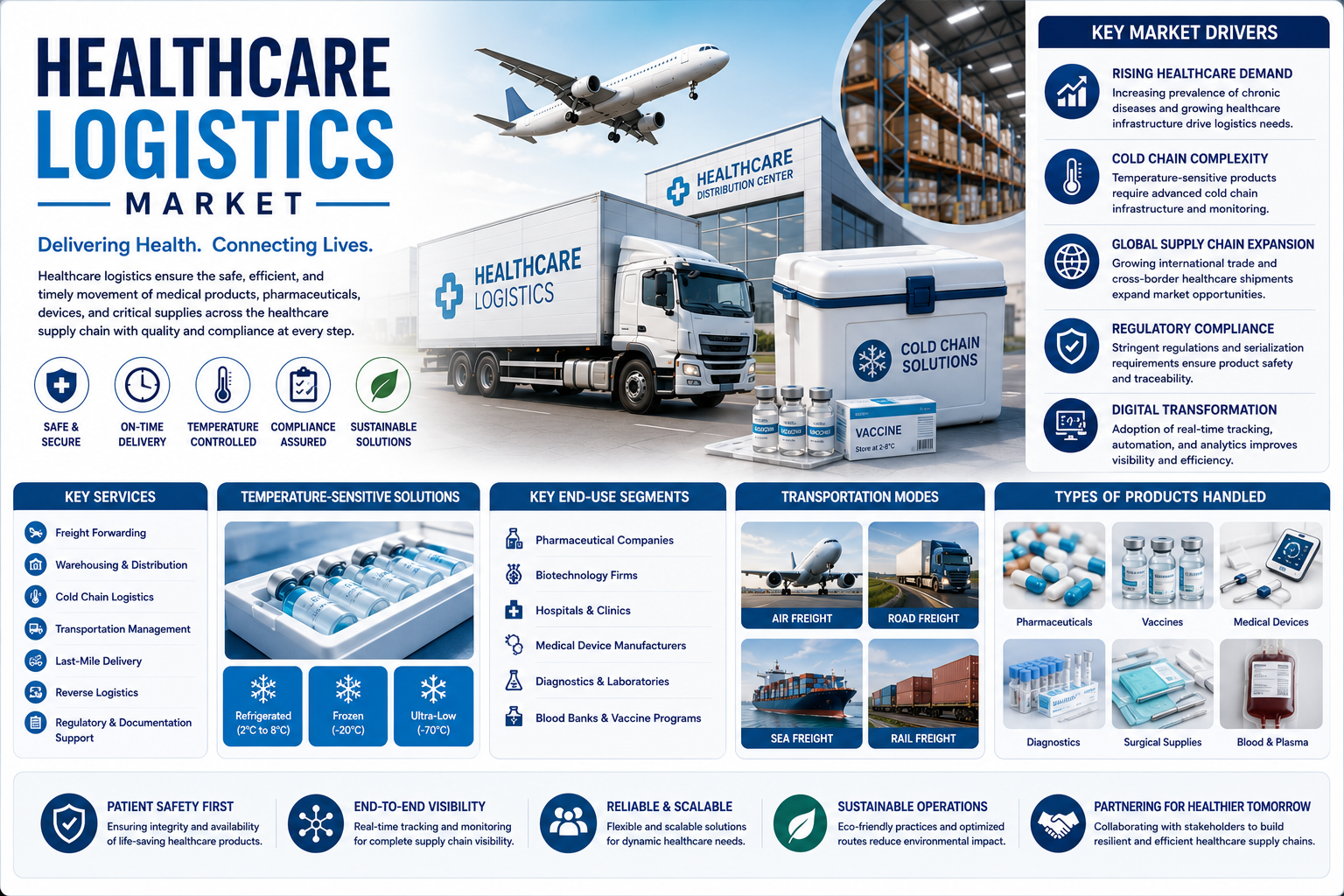

Europe contributes ~28% of global revenue, supported by EU GDP compliance frameworks and cross-border pharmaceutical distribution harmonization.
TX, UNITED STATES, July 29, 2026 /EINPresswire.com/ — The healthcare logistics market stood at an estimated USD 98.5 billion in 2025 and is projected to reach USD 205.0 billion by 2035, expanding at a compound annual growth rate of 7.6% during the 2026–2035 forecast window. Two catalysts are accelerating spending across the market: the global push to decentralize clinical trials, which demands precision-grade shipment networks, and a USD 4.1 billion allocation across G7 nations for pandemic-preparedness supply infrastructure under the WHO’s revised International Health Regulations. These policy commitments are converting what was once viewed as a cost center into a boardroom-level investment priority.
Digitalization is rewriting the operational playbook across the industry. Legacy paper-based track-and-trace systems are giving way to IoT-enabled sensors, blockchain-verified chain-of-custody platforms, and AI-driven demand-forecasting engines. The European Commission’s Falsified Medicines Directive serialization mandate, fully enforced since 2024, pushed more than 80% of EU-based distributors to adopt end-to-end digital verification within two years — a regulatory template now being replicated across Southeast Asia and South America.
North America commands approximately 38% of the global market, anchored by the United States’ dense specialty-pharmacy network and FDA Drug Supply Chain Security Act requirements. Asia-Pacific is the fastest-growing region at a projected 9.2% CAGR, fueled by India’s pharmaceutical export boom and China’s hospital modernization wave. Europe holds the second-largest share at roughly 28%, supported by the EU’s Good Distribution Practice framework. As biologics, cell and gene therapies, and personalized medicines expand their share of the therapeutic pipeline, the market is positioned for structural, rather than merely cyclical, growth through 2035.
Market Segmentation
By Service Type
Transportation accounts for the largest share of the market, capturing roughly 42% of global spend in 2025, reflecting the complexity of multi-modal pharmaceutical shipment routes. Air freight makes up around 15% of pharmaceutical transport by volume but over 40% by value, since high-value biologics and clinical trial materials demand speed and precision; ocean freight handles the bulk of active pharmaceutical ingredient and excipient shipments, while ground transportation forms the critical last-mile link. Warehousing and storage is the fastest-expanding infrastructure segment, growing at an 8.3% CAGR, as temperature-sensitive biologics — which grew from 25% of pharmaceutical revenue in 2015 to 38% in 2025 — drive investment in validated cold rooms, cryogenic storage, and ambient-controlled facilities. A single large-scale GDP-certified pharmaceutical warehouse costs USD 40–80 million to build and validate, creating high barriers to entry that favor established operators. Distribution and fulfillment generated about USD 21.6 billion in 2025, propelled by e-pharmacy and direct-to-patient channels, while value-added services — packaging, labeling, and regulatory documentation — generated roughly USD 12.4 billion in 2025 and are growing at an 8.8% CAGR, driven by serialization compliance mandates worldwide.
Get Report Sample Copy with TOC: https://www.marketresearchfuture.com/sample_request/11698
By Application
Pharmaceutical products dominate the application segment with over 55% share in 2025, led by specialty drugs and biosimilars. Specialty pharmaceuticals represent over 50% of US drug spending despite treating fewer than 2% of patients, and require temperature-controlled, chain-of-custody-verified distribution from manufacturer to specialty pharmacy to patient. Medical devices generated about USD 18.7 billion in 2025, driven by surgical kit logistics and sterilization chain requirements. Clinical trial logistics is the fastest-growing application, expanding at a 9.8% CAGR, as decentralized and hybrid trial designs require investigational products to reach patients at home rather than at clinical sites — creating demand for residential-grade cold-chain delivery, returns management, and real-time compliance documentation. Other applications, including diagnostics and blood products, held roughly 8% share in 2025, driven by the proliferation of point-of-care testing.
By End User
Pharmaceutical and biotechnology companies form the largest end-user segment, holding about 48% share in 2025. Third-party logistics outsourcing rates in pharmaceuticals reached 68% in 2024, up from 52% in 2018, as manufacturers increasingly recognize that validated logistics capabilities sit outside their core competencies. Hospitals and healthcare facilities are growing at a 7.2% CAGR, driven by group purchasing organization consolidation. Research laboratories generated about USD 5.1 billion in 2025, tied to reagent and sample logistics needs, while retail and e-pharmacy is the fastest-growing end-user segment at a 9.4% CAGR, fundamentally reshaping the last-mile architecture of pharmaceutical distribution as direct-to-consumer prescription delivery expands.
Regional Market Analysis
North America leads the global market with approximately 38% share in 2025, a dominance built on the world’s highest per-capita drug spending and the most complex specialty-pharmacy distribution system. Within the region, the United States accounts for roughly 82% of regional share, driven by the Drug Supply Chain Security Act’s final-phase enforcement and its dense specialty drug distribution network — the US processes over 4.7 billion prescriptions annually, and the law’s final interoperability requirements, effective November 2024, triggered an estimated USD 1.5 billion technology-upgrade cycle across wholesalers, hospitals, and dispensaries. Canada is growing at a 6.8% CAGR, supported by CAD 2.3 billion in government investment in biomanufacturing capacity through its Biomanufacturing and Life Sciences Strategy, while Mexico, valued at about USD 2.1 billion, is benefiting from the nearshoring of pharmaceutical packaging operations.
Europe holds roughly 28% of global share, supported by GDP harmonization, cross-border serialization efforts, and biologics hub development. Germany accounts for about 23% of regional share as Europe’s pharmaceutical logistics backbone, with Frankfurt and Leipzig operating as major air-cargo hubs processing over 120,000 metric tons of pharmaceutical shipments annually. The United Kingdom is growing at a 7.4% CAGR, as its post-Brexit independent regulatory regime has created a parallel logistics network that adds complexity for UK-bound shipments. France generated about USD 5.8 billion in 2025, driven by hospital group procurement centralization, while the rest of Europe holds about 38% of regional share, with Nordic countries pursuing cold-chain innovation and Eastern European nations like Poland, Hungary, and the Czech Republic emerging as cost-competitive pharmaceutical warehousing locations.
Asia-Pacific is the engine of growth for the market over the forecast period, expanding at a 9.2% CAGR — the fastest of any region. China holds the largest share within the region at about 35%, driven by a domestic biologics boom and hospital modernization; its 14th Five-Year Plan committed RMB 52 billion to pharmaceutical cold-chain modernization across tier-2 and tier-3 cities. India is growing fastest within the region at a 10.5% CAGR, having exported USD 27.9 billion in pharmaceutical products in fiscal year 2024 and targeting USD 40 billion by 2030 under its Production Linked Incentive scheme, alongside continued Gati Shakti infrastructure investment. Japan, valued at about USD 6.2 billion, is driven by an aging population — 29% of its citizens are over age 65 — that supports high-value specialty drug distribution volumes and premium logistics pricing. South Korea is growing at an 8.9% CAGR on the back of biosimilar manufacturing scale-up, while the rest of Asia-Pacific holds about 18% of regional share amid ASEAN pharmaceutical trade zone development.
South America, valued at about USD 4.3 billion in 2025, is being shaped by regulatory modernization and pandemic-preparedness investment. Brazil dominates the region with roughly 58% of regional share, supported by ANVISA’s progressive adoption of international serialization standards and its public healthcare system, which procures pharmaceuticals for 210 million citizens. Argentina is growing at a 7.1% CAGR on rising biosimilar adoption, while the rest of South America, valued at about USD 1.1 billion, benefits from PAHO-funded regional stockpile programs — the Pan American Health Organization’s Strategic Fund processed over USD 1.6 billion in pooled regional procurement orders in 2024 alone.
The Middle East and Africa region is growing at an 8.7% CAGR, driven by donor-funded cold-chain build-out and local manufacturing incentives. The UAE holds about 22% of regional share, having positioned Dubai and Abu Dhabi as pharmaceutical transshipment hubs connecting European manufacturers with African and South Asian markets. Saudi Arabia is growing at a 9.1% CAGR under its National Industrial Development and Logistics Program, which targets 40% local pharmaceutical manufacturing by 2030. South Africa, valued at about USD 0.9 billion, serves as the continent’s primary pharmaceutical distribution gateway, while the rest of the region is growing at 8.4% CAGR, with Gavi alone having invested USD 580 million in cold-chain equipment across 57 countries between 2021 and 2025.
Buy Now: https://www.marketresearchfuture.com/checkout?currency=one_user-USD&report_id=11698
Growth Drivers
Biologics and specialty drug pipeline expansion is the most significant growth driver, contributing an estimated 1.8 percentage points to CAGR globally over the long term. The global biologics market surpassed USD 420 billion in 2024 revenue, with over 900 biologic candidates in Phase II or III trials. Unlike small-molecule pills that tolerate ambient storage, most biologics require strict 2–8°C or even –80°C handling throughout their journey, which inflates logistics costs — biologic shipment costs run three to five times higher per unit than conventional pharmaceutical distribution. The FDA approved 50 novel biologic applications in 2024 alone, each generating new distribution network requirements.
Serialization and track-and-trace mandates contribute an estimated 1.4 percentage points to CAGR, concentrated in Europe and Asia-Pacific over the short term. The US Drug Supply Chain Security Act entered its final enforcement phase in November 2024, requiring transaction-level, interoperable tracing for all prescription medications. Alongside the EU’s Falsified Medicines Directive, India’s track-and-trace requirement for export pharmaceuticals, and South Korea’s integrated drug-management system, these mandates are estimated to have driven USD 2.8 billion of logistics-technology enhancements between 2023 and 2025 — and compliance is non-negotiable, since non-compliant items simply cannot enter distribution.
Decentralized clinical trial growth contributes roughly 1.2 percentage points to CAGR in North America and Europe over the medium term. Decentralized and hybrid trials grew from 8% of all registered trials in 2019 to 32% in 2024, and each requires direct-to-patient investigational product shipment, often under controlled temperature with real-time custody documentation — creating a high-margin service opportunity for providers with clinical-grade packaging and last-mile capabilities.
Pandemic-preparedness infrastructure investment adds an estimated 0.9 percentage points to CAGR globally over the medium term. Emerging market pharmaceutical manufacturing shifts contribute a similar 0.9 percentage points across Asia-Pacific and South America over the long term, while e-pharmacy and direct-to-patient distribution adds about 0.8 percentage points in North America and Asia-Pacific over the short term, as smaller parcel sizes, individual-level temperature monitoring, and residential delivery windows reshape service architecture. IoT and AI-enabled supply chain digitalization rounds out the driver set, contributing roughly 0.6 percentage points globally over the medium term.
Competitive Landscape
The market shows moderate concentration, with an estimated Herfindahl-Hirschman Index of roughly 650–800, reflecting a mix of global logistics conglomerates, specialized pharmaceutical third-party logistics providers, and large wholesale distributors. The top five players collectively hold an estimated 28–35% of global revenue, with the rest distributed among hundreds of regional operators, niche specialty-logistics firms, and local distributors.
DHL Supply Chain & Global Forwarding leads with an estimated 6–9% revenue share, operating the largest dedicated pharmaceutical logistics network globally through end-to-end pharmaceutical logistics and GDP-certified warehousing. UPS Healthcare holds roughly 5–7% share, anchored strongly in North America with global clinical reach through temperature-assured packaging and clinical trial logistics. FedEx Logistics holds an estimated 4–6%, emphasizing speed-to-patient through priority overnight pharma shipping and its SenseAware tracking platform. Kuehne+Nagel holds roughly 3–5% share, combining a European stronghold with Asia trade-lane depth through its KN PharmaChain integrated air-sea solutions.
McKesson Corporation holds an estimated 4–6% share, dominant in US-centric wholesale distribution and specialty pharmacy fulfillment. AmerisourceBergen, operating as Cencora, holds roughly 4–6% share with a dual positioning across wholesale distribution and high-value clinical logistics through its World Courier network. Cardinal Health holds an estimated 3–5% share, with particular strength in nuclear pharmacy logistics and medical device distribution. Marken, a UPS subsidiary, holds roughly 2–3% as a pure-play clinical logistics leader in clinical trial and biological sample shipment. DB Schenker holds an estimated 2–4% share through its deep European pharmaceutical freight network, while Nippon Express rounds out the top ten with roughly 1–3% share as a regional champion in Japan and Southeast Asian pharmaceutical distribution.
Report Summary: https://www.marketresearchfuture.com/reports/healthcare-logistics-market-11698
Recent Industry Developments
In July 2023, DHL partnered with Vizient to expand third-party logistics healthcare services and launched a specialized temperature-controlled facility with direct ramp access at Indianapolis International Airport, expanding cold-chain infrastructure for major biopharmaceutical manufacturers. In June 2026, UPS Healthcare announced a USD 48 million expansion project to build 27 temperature-controlled freight cross-dock facilities across North America, Europe, Asia, and South America, enhancing IATA CEIV Pharma-certified cold-chain capabilities for biologics, cell and gene therapies, and GLP-1 drug distribution. In November 2025, Kuehne+Nagel expanded its Integrated Logistics 4PL control tower network, deploying AI-driven predictive risk assessment tools and real-time monitoring across its global KN PharmaChain network. And in October 2024, the FDA issued updated Drug Supply Chain Security Act exemption notices, extending enforcement discretion for interoperable electronic tracing requirements until mid-to-late 2025 to give manufacturers, wholesalers, and dispensers time to ensure system readiness.
Related Report
direct to patient healthcare logistics market https://www.marketresearchfuture.com/reports/direct-to-patient-healthcare-logistics-market-41386
china pharmaceutical logistics market https://www.marketresearchfuture.com/reports/china-pharmaceutical-logistics-market-57143
vaccine logistic market https://www.marketresearchfuture.com/reports/vaccine-logistic-market-41816
US Pharmaceutical Logistics Market https://www.marketresearchfuture.com/reports/us-pharmaceutical-logistics-market-one-18415
US Healthcare Logistics market https://www.marketresearchfuture.com/reports/us-healthcare-logistics-market-15800
high tech logistics market https://www.marketresearchfuture.com/reports/high-tech-logistics-market-41653
Market Research Future
Market Research Future
+ +1 855-661-4441
email us here
Legal Disclaimer:
EIN Presswire provides this news content “as is” without warranty of any kind. We do not accept any responsibility or liability
for the accuracy, content, images, videos, licenses, completeness, legality, or reliability of the information contained in this
article. If you have any complaints or copyright issues related to this article, kindly contact the author above.

Media gallery