A2 Dairy Product Market to Hit USD 105.03 Billion by 2035, Fueled by Growing Health and Wellness Trends
A2 Dairy Product Market is expanding as consumers seek nutritious, premium dairy focused on digestion, wellness,

Press Release Disclaimer: This is a press release distributed through the XPR Media network. It has not been independently verified by our newsroom.
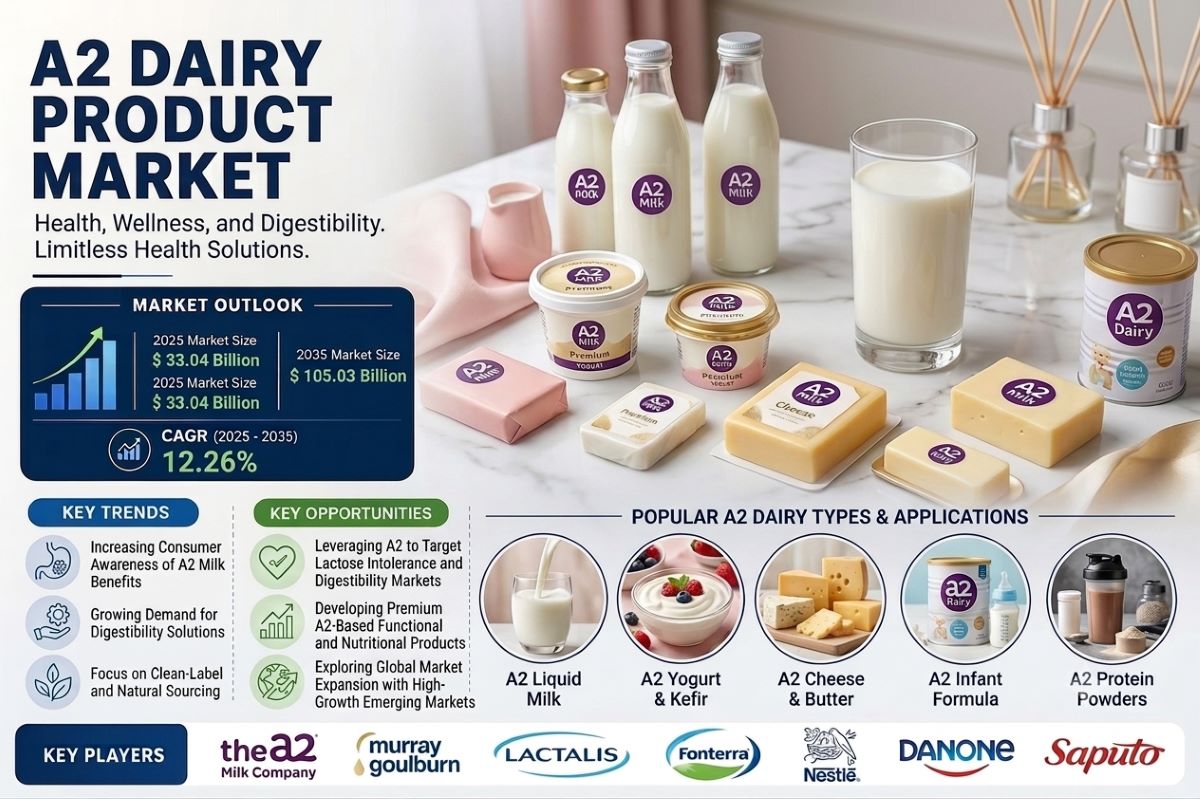

A2 Dairy Product Market is expanding as consumers seek nutritious, premium dairy focused on digestion, wellness, clean-label products & personalized nutrition.
NEW YORK, NY, UNITED STATES, August 24, 2026 /EINPresswire.com/ — A2 Dairy Product Market Overview:
The A2 Dairy Product Market Growth is entering a significant period of transformation as consumers increasingly assess dairy products based on nutrition, digestion, wellness, and dietary suitability. According to the provided assessment, the market was valued at USD 29.43 billion in 2024 and is expected to reach USD 33.04 billion in 2025. It is projected to expand to USD 105.03 billion by 2035, representing a 12.26% CAGR from 2025 to 2035. This strong expansion reflects changing consumer expectations, growing awareness of milk proteins, premiumization across dairy categories, and rising interest in products perceived as compatible with individual dietary preferences. A2 dairy products are gaining attention because they contain A2 beta-casein rather than the A1 and A2 combination commonly found in conventional milk. This distinction is becoming increasingly relevant within the premium dairy segment as consumers look beyond traditional nutritional labels and explore product composition and perceived functional benefits.
The category is further supported by growing consumer access to nutritional information through digital media, wellness communities, food education, and changing purchasing habits. Consumers are increasingly interested in understanding the origin, composition, and characteristics of the dairy products they purchase. This trend is creating opportunities for specialized dairy products to compete through differentiated nutritional positioning, quality, transparency, and perceived wellness benefits. At the same time, personalized nutrition is encouraging consumers to consider dairy choices according to lifestyle preferences, digestion concerns, wellness objectives, and dietary routines. As awareness continues to develop, innovation, product diversification, and premium offerings are expected to remain important factors shaping the future of the A2 dairy industry.
Rising Consumer Awareness Supports Category Development:
Consumer awareness represents one of the strongest forces shaping the A2 dairy landscape. Many shoppers are becoming more interested in how food components may influence their individual experiences, particularly when it comes to digestion and overall dietary comfort. This has encouraged greater attention toward different milk proteins and specialized dairy formulations.
The discussion surrounding A2 milk has also expanded beyond traditional dairy consumers. Health-conscious shoppers, fitness-oriented consumers, families, and individuals interested in functional nutrition are increasingly exposed to information about specialized dairy products. As awareness spreads, consumers may become more receptive to trying A2 milk and related products as part of their regular diets.
However, market development depends heavily on responsible communication. A2 products should not automatically be positioned as suitable for everyone with lactose intolerance or as a medical solution. Lactose intolerance is associated with difficulty digesting lactose, while A2 refers to the beta-casein protein profile of milk. Clear consumer education can help brands build credibility while avoiding confusion between these distinct dietary considerations.
Health and Wellness Trends Reshape Dairy Consumption:
The broader wellness movement is creating new opportunities for differentiated dairy. Consumers increasingly expect food products to deliver value beyond basic calories and macronutrients. Dairy is particularly well positioned because milk and dairy foods naturally provide nutrients such as protein, calcium, and other essential components.
A2 dairy can benefit from this environment because its specialized protein composition gives brands a distinctive story to communicate. Rather than competing solely on price, companies can focus on quality, provenance, processing, animal husbandry, nutrition, and product differentiation.
The growth of personalized nutrition is another relevant development. Consumers are increasingly interested in food choices that fit their personal routines and perceived dietary requirements. This does not necessarily mean that every consumer will switch to A2 dairy, but it expands the space for specialized products that allow shoppers to make more deliberate purchasing decisions.
Product Innovation Expands the Opportunity:
Product innovation is expected to remain central to market development through the forecast period. While liquid milk remains an important product format, companies can reach additional consumers through yogurt, cheese, butter, cream-based products, infant nutrition, beverages, and other dairy applications.
Innovation can also address changing consumption occasions. Convenient single-serve products can appeal to busy consumers, while high-protein dairy products may attract fitness-oriented shoppers. Yogurt and fermented dairy can connect with consumers interested in digestive wellness, while premium cheese and specialty dairy can target shoppers seeking differentiated taste and quality.
Manufacturers can further expand their portfolios through flavored products, fortified formulations, convenient packaging, and products designed for specific age or lifestyle groups. The ability to offer A2 dairy in familiar formats can reduce the barrier to adoption because consumers do not have to significantly change their eating habits.
Get Full PDF Sample Copy of Report: (Including Full TOC, List of Tables & Figures, Chart) @
https://www.marketresearchfuture.com/sample_request/38315
Packaging Innovation Strengthens Premium Positioning:
Packaging plays an increasingly important role in communicating product differentiation. In a crowded dairy aisle, packaging can help consumers quickly identify the A2 proposition and understand the product’s key characteristics.
Modern packaging strategies emphasize clarity, traceability, convenience, freshness, and premium presentation. Resealable containers, single-serve formats, recyclable materials, and easy-to-read nutritional information can support purchasing decisions. For specialized dairy products, packaging also serves an educational function by explaining the A2 protein distinction without overwhelming consumers with technical terminology.
Sustainability is becoming another consideration. Consumers increasingly examine packaging waste and sourcing practices when evaluating food brands. Dairy companies that combine differentiated nutrition with responsible packaging and transparent supply chains may be better positioned to build long-term consumer trust.
Market Segment Insights:
By Type:
A2 Fresh Milk dominates the market due to broad availability and growing consumer awareness of A2 beta-casein. A2 Yogurt is the fastest-growing segment, supported by rising demand for probiotic foods and healthier snack options.
By Product:
A2 Fresh Milk remains dominant, driven by its perceived digestibility and wellness appeal. A2 Ghee is gaining attention among health-conscious consumers seeking traditional, nutrient-rich cooking fats.
By Packaging Type:
Cups lead due to convenience, portability, and popularity for single-serve dairy products. Pouches are emerging as a flexible, lightweight option, particularly among younger and convenience-focused consumers.
By Distribution Channel:
Supermarkets and hypermarkets hold the largest share due to their broad reach, product variety, and promotional offerings. Online retailers are growing rapidly as e-commerce, home delivery, and digital shopping gain popularity.
By End-Use:
Household Consumption dominates, supported by increasing interest in wellness-oriented dairy products. Food Processing is emerging as manufacturers incorporate A2 dairy ingredients into snacks, baked goods, and other food applications.
By Health Benefit:
Improved Digestion leads as consumers increasingly prioritize gut health and digestive wellness. Boosted Immunity is gaining momentum alongside rising interest in preventive health and nutrition-focused dairy products.
Regional Outlook:
The market assessment covers North America, Europe, Asia-Pacific, South America, and the Middle East & Africa, with regional development shaped by different dairy consumption patterns, consumer incomes, health trends, distribution structures, and regulatory environments.
North America represents an important environment for premium and differentiated dairy products. Consumers in the region have demonstrated strong interest in wellness-oriented foods, specialty nutrition, clean-label positioning, and functional products. Established retail infrastructure and growing online grocery adoption can support wider availability of A2 dairy offerings.
Europe has a mature dairy industry and a strong consumer focus on food quality, provenance, sustainability, and nutritional characteristics. The region’s sophisticated dairy ecosystem provides opportunities for specialized products, although competition from established dairy brands and alternative milk categories can influence market positioning.
Asia-Pacific offers substantial long-term potential because of its large population, expanding middle class, rising disposable incomes, and growing awareness of premium nutrition. Consumer preferences differ significantly across individual countries, but increasing interest in high-quality dairy and specialized nutrition can support category development. The region is particularly important for companies seeking new consumers and expanding premium dairy portfolios.
South America combines established dairy consumption with opportunities created by changing food preferences and rising awareness of specialized products. Expansion will depend on affordability, distribution reach, consumer education, and the ability of companies to establish reliable supply chains.
The Middle East & Africa can provide emerging opportunities as urbanization, modern retail development, and premium food consumption increase. Market penetration may initially be stronger in higher-income urban areas, while broader expansion will depend on pricing, availability, consumer awareness, and local distribution networks.
Competitive Landscape:
The competitive environment includes established international dairy businesses as well as specialized A2-focused companies. The companies identified in the provided assessment include A2 Milk Company
▪️Murray Goulburn
▪️Lactalis
▪️Fonterra
▪️Nestlé
▪️Danone
▪️Saputo
▪️Arla Foods
▪️Stonyfield Farm.
Competition is expected to focus on product quality, brand credibility, distribution, supply chain management, innovation, and consumer education. Companies with strong dairy expertise can leverage established production capabilities and retail relationships, while specialized A2 brands can compete through focused positioning and consumer recognition.
Product portfolio expansion is likely to remain an important competitive strategy. Companies may seek to introduce A2 versions of familiar dairy products rather than limiting their offerings to conventional milk. This approach can increase consumer touchpoints and strengthen brand presence across different consumption occasions.
Supply chain control can also provide an advantage. Because A2 dairy depends on the underlying milk protein profile, sourcing and herd management are important components of product consistency. Companies that can demonstrate reliable sourcing and transparent production practices may strengthen consumer confidence.
Key Market Opportunity: Growing Preference for Specialized Dairy:
One of the most important opportunities comes from the growing preference for dairy products perceived to offer specific health or dietary advantages. Consumers increasingly seek food products that align with personal wellness priorities, creating opportunities for specialized formulations.
A2 dairy can benefit from this trend by positioning itself around differentiation, quality, transparency, and consumer choice. The opportunity is particularly strong when brands provide clear explanations of what A2 protein means and how their products differ from conventional dairy.
The category can also benefit from premiumization. Consumers are increasingly willing to explore higher-value food products when they perceive meaningful differences in ingredients, sourcing, processing, or nutritional characteristics. This creates opportunities for manufacturers to develop premium A2 dairy ranges rather than competing entirely through volume and price.
Challenges Facing the Industry:
Despite its strong outlook, the industry faces challenges. Consumer understanding of A2 protein remains uneven, and some shoppers may find it difficult to distinguish between A2-related claims and broader lactose-intolerance discussions. Effective education will therefore be essential.
Price is another consideration. Specialized dairy products may command higher prices because of sourcing, herd management, production, certification, packaging, and distribution requirements. During periods of economic pressure, some consumers may prioritize conventional dairy products based on affordability.
Supply availability can also affect expansion. Scaling A2 dairy production requires appropriate herd management and reliable sourcing. Companies expanding rapidly must ensure that supply can grow without compromising product consistency or quality.
Competition from plant-based beverages and other specialized nutrition products represents another challenge. Consumers seeking digestive comfort or alternative dietary choices have an expanding range of products from which to choose. A2 dairy brands must therefore communicate a compelling value proposition while maintaining taste, quality, and convenience.
Technology and Supply Chain Development:
Technology is expected to support the industry’s evolution through improved herd identification, milk testing, traceability, production monitoring, and supply chain management. Better data systems can help producers and processors maintain consistency while improving operational efficiency.
Digital traceability can also strengthen consumer confidence. Consumers increasingly want to know where their food originates and how it is produced. Providing accessible information about sourcing and processing can make specialized dairy products more credible and differentiated.
Retail technology will contribute as well. E-commerce platforms, personalized recommendations, digital advertising, and online educational content enable brands to reach targeted consumer groups more efficiently than traditional channels alone.
Future Outlook Through 2035:
The outlook for the A2 Dairy Product Market remains positive, supported by changing consumer attitudes toward nutrition and increasingly differentiated food choices. The projected rise from USD 33.04 billion in 2025 to USD 105.03 billion by 2035 highlights the significant commercial opportunity available to dairy producers, processors, retailers, and ingredient suppliers.
Over the coming years, the market is likely to evolve from a primarily specialized milk category into a broader ecosystem of A2-based dairy foods and beverages. Innovation across yogurt, cheese, butter, nutritional products, beverages, and other applications could expand consumer engagement.
The industry’s long-term success will depend on more than consumer curiosity. Brands will need to demonstrate consistent product quality, maintain transparent sourcing, invest in consumer education, and create products that deliver convenience and enjoyable taste alongside differentiation.
The continued rise of personalized nutrition may further strengthen the category. As consumers become more comfortable tailoring food choices to individual preferences, specialized dairy products could gain greater relevance. At the same time, companies must ensure that product communications remain scientifically responsible and comply with applicable regulations.
Frequently Asked Questions?
1. What is the A2 Dairy Product Market?
The A2 Dairy Product Market covers milk and dairy foods produced from milk containing A2 beta-casein, including products such as milk, yogurt, cheese, butter, and specialized nutritional offerings.
2. What is driving demand for A2 dairy products?
Growing health awareness, interest in personalized nutrition, demand for premium dairy, and consumer interest in products perceived as easier to digest are among the major factors supporting demand.
3. How large could the A2 Dairy Product Market become by 2035?
According to the provided market assessment, the market is projected to reach USD 105.03 billion by 2035, expanding at a CAGR of 12.26% from 2025 to 2035.
4. Which regions are covered in the A2 Dairy Product Market assessment?
The assessment covers North America, Europe, Asia-Pacific, South America, and the Middle East & Africa.
Discover Related Research Reports By Market Research Future:
Dairy-Free Spread Market:
https://www.marketresearchfuture.com/reports/dairy-free-spread-market-37608
Dairy Free Infant Formula Market:
https://www.marketresearchfuture.com/reports/dairy-free-infant-formula-market-38031
Dairy Replacer Market:
https://www.marketresearchfuture.com/reports/dairy-replacer-market-38078
Dairy Free Cheese Market:
https://www.marketresearchfuture.com/reports/dairy-free-cheese-market-40718
Dairy Free Ice Cream Market:
https://www.marketresearchfuture.com/reports/dairy-free-ice-cream-market-41490
Market Research Future
Market Research Future
+1 855-661-4441
email us here
Legal Disclaimer:
EIN Presswire provides this news content “as is” without warranty of any kind. We do not accept any responsibility or liability
for the accuracy, content, images, videos, licenses, completeness, legality, or reliability of the information contained in this
article. If you have any complaints or copyright issues related to this article, kindly contact the author above.

Media gallery