What Happens After the Insight? Equipo’s Take on the Next Era of Healthcare Intelligence
Equipo explores how healthcare organizations can turn data and AI-driven insights into connected workflows, actionable

Press Release Disclaimer: This is a press release distributed through the XPR Media network. It has not been independently verified by our newsroom.
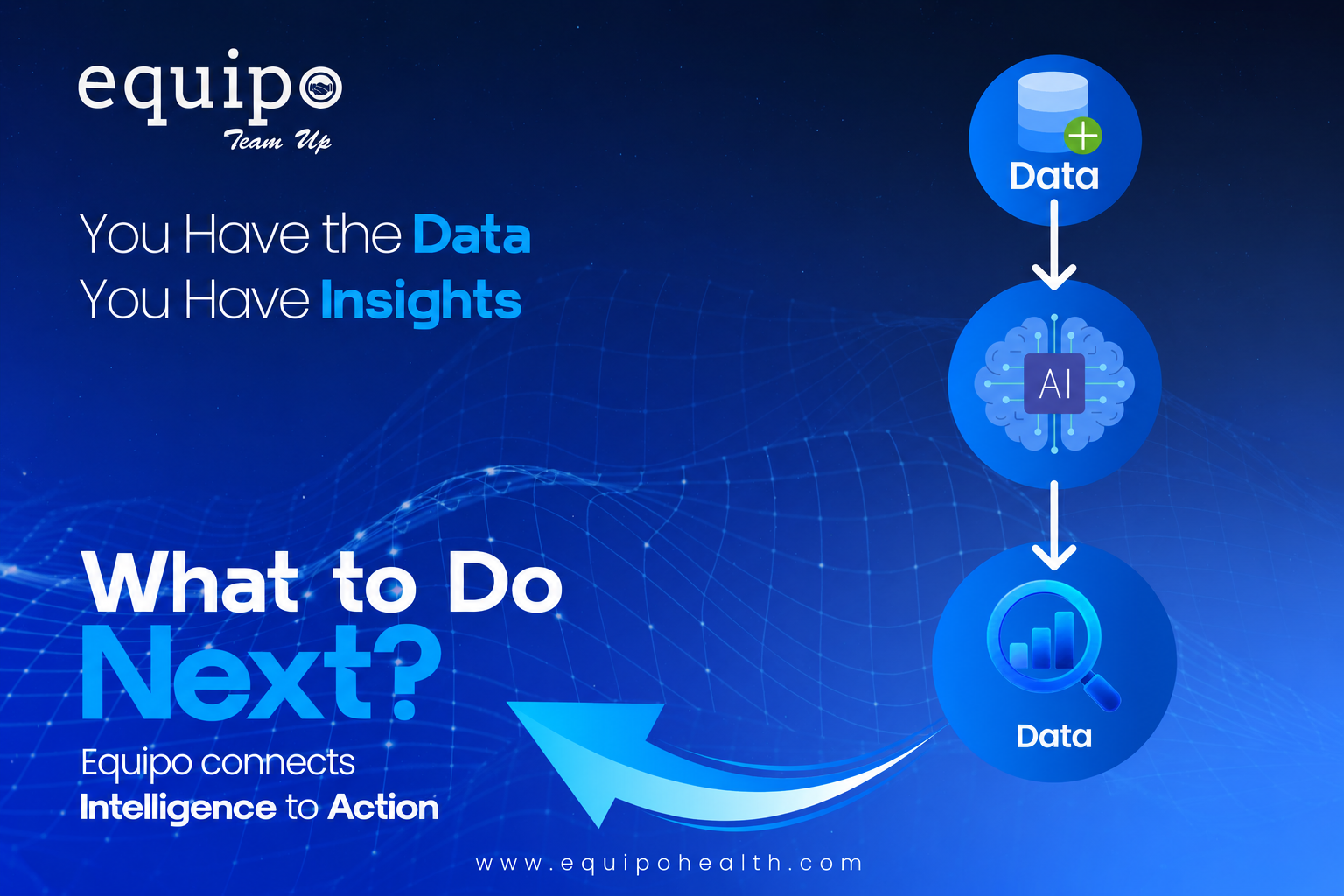

Equipo explores how healthcare organizations can turn data and AI-driven insights into connected workflows, actionable interventions and better outcomes.
SOUTH PLAINFIELD, NJ, UNITED STATES, August 12, 2026 /EINPresswire.com/ — Healthcare has become exceptionally good at finding what needs attention. The harder question is what happens next.
For more than a decade, Equipo has worked across the operational realities of healthcare, where the value of intelligence is ultimately measured by what care teams can do with it. Organizations can identify risk, uncover care gaps, analyze utilization and bring together clinical and claims information with greater precision than ever before. For healthcare leaders, the harder question is whether that information transforms to care and reaches the right person, at the right moment, with a clear next step.
That gap is increasingly operational. A care gap may be identified, but someone still has to prioritize it. A patient may be flagged as high risk, but the insight still has to translate into outreach, referral, follow-up, or intervention. The value of intelligence is realized only when it changes what happens next.
This is the space Equipo is designed to address. Rather than treating intelligence as another layer of reporting, Equipo connects insights to the operational actions required to move care forward.
From identifying opportunities to moving care forward
Healthcare systems can now identify patient needs with increasing precision. EHRs, claims data and other clinical sources can reveal care gaps, utilization patterns, medication risks and patients who may need additional support.
But an insight is only the starting point. A care gap identified in a population does not close on its own. A high-risk patient flagged by a predictive model does not receive an intervention simply because the risk was detected. A referral generated in a system does not guarantee that the patient reaches the appropriate provider.
Consider a patient recently discharged from the hospital. Their clinical and claims information may indicate chronic conditions, a new prescription, recent emergency department utilization and overdue preventive care. These signals can help identify that the patient needs attention.
The next step is action. The patient may need outreach to confirm medication access. A follow-up appointment may need to be scheduled. A referral may need to be coordinated. Additional concerns may need to be escalated to the appropriate care team. Each action creates another point in the patient’s care journey.
The outcome then depends on what happens across those steps: whether the patient is reached, whether the referral is completed, whether follow-up occurs and whether the intervention addresses the identified need.
This creates a simple but important progression:
Insight identifies the opportunity. Action addresses it. Outcomes show whether it made a difference. That progression is particularly important in value-based care, where organizations are accountable not simply for identifying patient needs, but for improving quality, coordinating care and managing utilization.
Value-based care puts greater weight on follow-through
In value-based care, the distance between identifying a need and addressing it can directly affect performance.
A care gap represents an opportunity for intervention. A referral creates a pathway to care. A medication adherence signal identifies a patient who may need support. A transition-of-care risk highlights the need for timely follow-up.
In each case, the insight has value only when the organization can act on it.
Better prioritization can help care teams focus limited resources on patients who need intervention most. Connected workflows can help move referrals, outreach and follow-up forward. Patient engagement can extend those interactions beyond the clinical encounter.
The result is a shift in how healthcare organizations can think about intelligence to act more effectively on what they know.
Healthcare intelligence is becoming operational
This evolution is reflected in the Equipo Ecosystem, where clinical and claims intelligence, population health, care management, referral coordination, patient engagement, analytics and AI-enabled capabilities are connected across operational pathways.
Clinical and claims information can provide broader patient context. Population health capabilities can help identify opportunities across a patient population. Predictive and detection capabilities can surface risks that warrant attention. Care management and referral workflows can translate those signals into action, while patient engagement capabilities extend interaction beyond the clinical encounter.
The resulting activity can then remain connected to the patient journey, giving organizations greater visibility into what happened after the original insight.
The significance is not simply having multiple capabilities within one environment. It is maintaining continuity between them.
Healthcare itself is not modular from the patient’s perspective. A clinical finding can lead to a referral. The referral can require outreach. Outreach can lead to an appointment. The appointment can lead to another intervention. When context is lost between these moments, care teams spend time reconstructing information and patients can experience unnecessary friction.
A connected operational environment reduces that distance. For healthcare organizations managing increasingly complex populations, this continuity can become an important part of operational capacity. Intelligence becomes information that can move with the work.
AI is moving from insight generation to workflow participation
Artificial intelligence is accelerating this evolution. Predictive models and intelligent systems can help identify clinical risks, summarize information, recognize patterns, prioritize patients and reduce administrative effort. But their value increasingly depends on where those capabilities sit within the broader care process.
An AI model that identifies potential deterioration can provide an important signal. That signal becomes more useful when it reaches the appropriate care team with enough context to support a response. Similarly, automated document intelligence can reduce the effort required to interpret clinical information, while intelligent workflows can help translate that information into operational activity.
This is an important direction for AI in healthcare: moving closer to the work rather than creating another destination outside it.
Within the Equipo Ecosystem, AI-enabled capabilities are designed to contribute across this continuum, from detecting risks and interpreting information to supporting care workflows and reducing the administrative effort required to act.
At the end of the day, the objective is to make existing intelligence more usable.
The Shift Toward Connected Healthcare Intelligence
The evolution of healthcare intelligence is ultimately not about generating more information. It is about making intelligence more actionable within the realities of care delivery.
The Equipo Ecosystem reflects the direction of making intelligence more actionable within the realities of care delivery through a connected operational environment.The data, intelligence, people and workflows work together across the patient journey. Intelligence can move with the work—informing prioritization, activating workflows, supporting intervention and remaining connected to the actions and outcomes that follow.
For healthcare organizations, this connectivity can have a broader operational impact. It can support more coordinated care delivery, strengthen population management, improve visibility across workflows and help teams translate identified opportunities into action. In value-based care, where performance depends significantly on what happens between and beyond individual clinical encounters, where operational continuity becomes particularly important.
The broader takeaway is that the next era of healthcare intelligence will be defined not only by how accurately organizations identify what needs attention, but by how effectively they connect that intelligence to the work required to address it.
Prince Mamman
Connect Care
+1 732-221-1050
email us here
Visit us on social media:
LinkedIn
Instagram
X
Legal Disclaimer:
EIN Presswire provides this news content “as is” without warranty of any kind. We do not accept any responsibility or liability
for the accuracy, content, images, videos, licenses, completeness, legality, or reliability of the information contained in this
article. If you have any complaints or copyright issues related to this article, kindly contact the author above.

Media gallery