Vadzo Imaging Launches Falcon-2020MRS, a 20MP Monochrome USB Camera Built on the Onsemi AR2020 Sensor for High-Resolution Industrial Inspection
Vadzo Imaging introduces the Falcon-2020MRS, a 20MP monochrome USB camera module engineered for OEM developers and

Press Release Disclaimer: This is a press release distributed through the XPR Media network. It has not been independently verified by our newsroom.


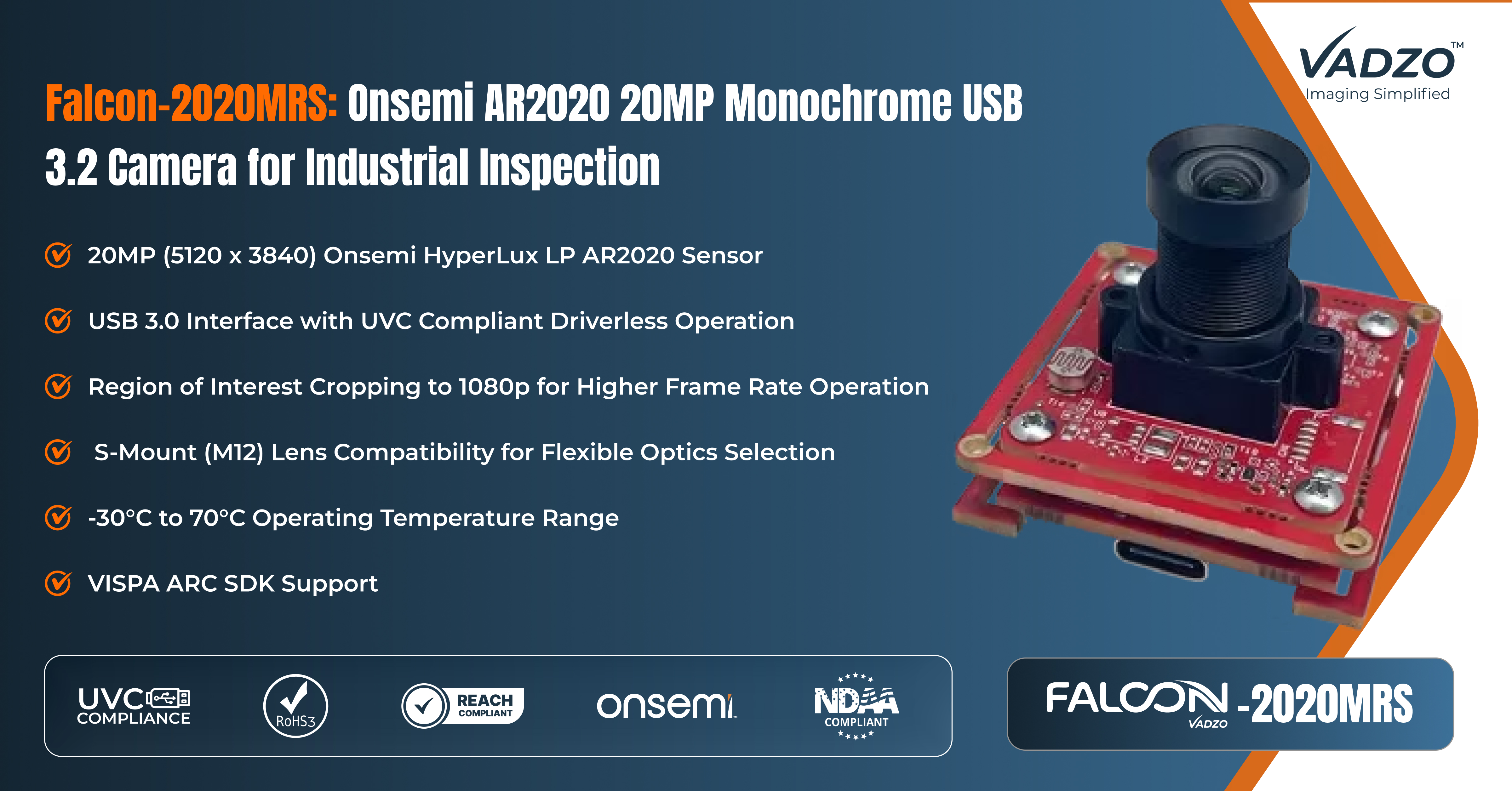
Vadzo Imaging introduces the Falcon-2020MRS, a 20MP monochrome USB camera module engineered for OEM developers and machine vision integrators building high-resolution industrial inspection systems. Built on the onsemi HyperLux LP AR2020 sensor, the camera module delivers 5120 x 3840 resolution over a USB 3.2 interface, giving inspection engineers the pixel density required for fine defect detection, precision measurement, and large-area scene reconstruction from a single production-ready module.
FORT WORTH, TX / ACCESS Newswire / August 5, 2026 / Vadzo Imaging today announced the launch of the Falcon-2020MRS, a 20MP monochrome USB camera module built around the onsemi HyperLux LP AR2020 sensor. Designed for OEM developers and system integrators working on automated optical inspection, precision measurement, and large-format embedded vision applications, the Falcon-2020MRS pairs 20MP spatial resolution with a USB 3.2 interface and UVC-compliant, driverless operation, giving engineering teams a 20MP rolling shutter camera that integrates without custom driver development.
Onsemi HyperLux LP AR2020: Pixel Architecture for 20MP Monochrome Inspection Imaging
The Falcon-2020MRS is built on the onsemi HyperLux LP AR2020, a 20MP CMOS sensor in a 1/1.8-inch optical format with a 1.4 µm pixel pitch, delivering a native resolution of 5120 x 3840 pixels. As a monochrome sensor, the AR2020 captures light directly on every pixel without a Bayer color filter array, eliminating the color interpolation step a color sensor must perform to reconstruct a full-resolution image from filtered pixel data. That difference improves photon capture per pixel and contrast resolution, both of which matter when the inspection task depends on detecting sub-millimeter surface defects, hairline cracks, or fine print misregistration under structured or variable illumination.
The AR2020 uses a rolling shutter readout, which reads sensor rows sequentially rather than capturing the full frame at a single instant. For inspection tasks where the part is stationary during capture, or where inspection passes are performed at controlled, matched motion velocity, rolling shutter behavior is predictable and does not introduce measurable positional distortion. Inspection engineers running continuous conveyor lines at variable throughput speeds should evaluate exposure timing and part velocity together during integration, since rolling shutter readout order determines how motion during exposure appears across the frame. To support flexibility across these deployment profiles, the Falcon-2020MRS camera module supports Region-of-Interest cropping down to 1080p, allowing engineers to trade full 20MP coverage for higher frame rate operation when a defined inspection zone, rather than the full sensor area, is the target.
Product Overview
The Falcon-2020MRS packages the 20MP AR2020 monochrome sensor in a compact USB 3.2 camera module with an S-Mount M12 lens holder, giving integrators a standardized optical interface for lens selection and replacement. The module operates across a -30°C to 70°C range, supporting deployment in unconditioned factory floor environments as well as temperature-controlled inspection cells. As a UVC-compliant camera product, the Falcon-2020MRS enumerates as a standard video class device on Windows, Linux, and Android without a proprietary driver. Vadzo’s VISPA ARC SDK provides programmatic access to exposure, gain, and Region-of-Interest settings for engineering teams building custom inspection pipelines.
Falcon-2020MRS Specifications
|
Sensor |
Onsemi AR2020 HyperLux LP |
|
Chroma |
Monochrome |
|
Resolution |
20MP (5120 x 3840) |
|
Sensor Format |
1/1.8″ |
|
Pixel Size |
1.4µm x 1.4µm |
|
Shutter Type |
Rolling Shutter |
|
Interface |
USB 3.2 Gen1 Type C Interface Backward Compatible to USB 2.0 |
|
Optics |
S-Mount (M12 Standard) |
|
Operating Temperature |
-30°C to 70°C |
|
Compliance |
UVC Compliant, RoHS 3, REACH |
|
SDK |
VISPA ARC SDK (C, C++, Python) |
|
Supported Platforms |
Windows, Linux, Android |
“Inspection engineers do not need more pixels for their own sake. They need enough pixels to catch the defect that matters at the throughput their line runs at. That was the design brief behind the Falcon-2020MRS. 20MP let a single camera module cover a wider inspection lane without giving up the pixel density that defect detection depends on. Region-of-Interest cropping gives engineers a way to trade that resolution for frame rate when the application calls for it, instead of forcing a single fixed architecture.” – Alwin Vincent, Product Manager, Vadzo Imaging.
Key Capabilities of the Falcon-2020MRS
20MP Resolution for Wide Field-of-View Defect Detection: Inspection lines covering wide conveyor lanes, large, printed circuit panels, or full-sheet material webs have historically required multiple 2MP or 5MP camera modules stitched together to maintain defect detection sensitivity across the full scene width. The Falcon-2020MRS resolves this by covering the same Field-of-View with 5120 x 3840 pixels from a single sensor, maintaining pixel density per millimeter of scene width even as the inspection lane widens. This reduces the number of camera modules, lighting stations, and synchronization points a system integrator must design, calibrate, and maintain across the production line.
Region-of-Interest Cropping for Mixed Throughput Inspection Cells: Production environments rarely run a single inspection task at a single frame rate. A cell may need full sensor coverage for a periodic detailed scan and a faster, cropped capture for high throughput pass or fail screening in the same shift. The Falcon-2020MRS addresses this by supporting Region-of-Interest cropping down to 1080p, letting engineers configure the camera module for full 20MP capture during detailed inspection passes and a cropped, higher frame rate mode when only a defined inspection zone needs to be evaluated at production line speed.
Target Applications for the Falcon-2020MRS Industrial Inspection Camera Module
Automated Optical Inspection for PCB and Semiconductor Manufacturing: Printed circuit board assembly and semiconductor packaging lines depend on automated optical inspection to catch solder defects, component placement errors, and trace-level irregularities before a board moves to the next process step. The Falcon-2020MRS AR2020 Industrial Inspection Camera supports fine-pitch defect detection across full panel widths, reducing the 20MP Inspection Camera count needed to maintain inspection coverage on wide panel or gang-up production lines. As an Automated visual inspection camera module, it integrates into existing AOI stations without requiring a change to established lighting or fixture geometry.
Precision Measurement and Tolerance Validation: Dimensional measurement systems that validate part tolerances against CAD reference models require consistent pixel-to-millimeter calibration across the full Field-of-View. The monochrome sensor and 20MP resolution of the Falcon-2020MRS give metrology engineers the spatial resolution needed for sub-millimeter Tolerance Validation Camera on machined parts, molded components, and assembled subsystems, supporting repeatable measurement accuracy across production batches without resorting to multi-camera scanning rigs for a single part.
Surface Defect Inspection on Production and Packaging Lines: Surface finish inspection for machined metal parts, coated surfaces, and packaging materials depends on resolving fine scratches, contamination, and print misregistration under variable illumination. The Falcon-2020MRS monochrome CMOS architecture captures light directly on every pixel without color filter interpolation, improving contrast resolution for surface defect detection tasks where subtle tonal variation, rather than color, is the signal engineers are inspecting.
Infrastructure and Remote Visual Inspection: Pipeline inspection, bridge structural monitoring, and other infrastructure inspection tasks increasingly rely on AR2020 High Resolution Inspection Camera to detect corrosion, cracking, and material fatigue from a fixed or remotely positioned camera module rather than manual close-range inspection. The wide field-of-view coverage available from the Falcon-2020MRS 20MP sensor supports infrastructure inspection camera deployments where a single fixed installation must resolve fine surface detail across a large structural area, reducing the number of inspections passes and camera repositioning required.
Calibration Systems and Optical Metrology: A calibration System Camera that verifies optical alignment, lens distortion, or sensor positioning across a production test bench requires a reference camera module with resolution and pixel geometry stable enough to serve as the measurement baseline. The Falcon-2020MRS fixed 1.4 µm pixel pitch and 20MP resolution give calibration system designers a consistent, well-characterized imaging reference for optical test stations and metrology fixtures used in production qualification.
VISPA ARC SDK and Driverless Integration
The Falcon-2020MRS is supported by Vadzo’s VISPA ARC SDK, which provides programmatic control over exposure, gain, Region-of-Interest configuration, and firmware updates through C, C++, and Python application programming interfaces across Windows, Linux, and Android platforms. For integration teams using standard driver frameworks rather than the SDK, the Falcon-2020MRS operates natively under UVC, V4L2, and DirectShow, allowing the camera module to enumerate as a standard video class device without a proprietary driver dependency. This reduces integration overhead for inspection of system builders working with existing machine vision software frameworks and third-party image processing libraries that expect standard UVC device enumeration.
Frequently Asked Questions
Q: What resolution does a embedded vision camera need for reliable automated defect detection?
A: Resolution requirements for automated defect detection depend on the smallest feature size that must be resolved, and the Field-of-View the camera module must cover in a single frame. As a general rule, reliable defect detection requires at least two to three pixels across the smallest defect dimension the system needs to flag, meaning the required sensor resolution scales directly with field-of-view width. A 2MP sensor covering a narrow 50mm inspection zone can resolve sub-millimeter defects comfortably, but the same sensor covering a 300mm conveyor lane loses that pixel density and may miss defects at the edges of the frame. embedded vision engineers evaluating sensor resolution for a wide field-of-view inspection task should calculate pixels per millimeter at the actual working Field-of-View rather than relying on total MP count alone, since two sensors with the same MP rating can deliver very different effective resolution depending on Field-of-View and lens selection.
Q: Which USB camera is best suited for high-resolution defect detection and precision measurement in industrial inspection?
A: For inspection tasks that require resolving fine defects across a wide Field-of-View or validating tight dimensional tolerances, Vadzo’s Falcon-2020MRS is built specifically for this requirement. It is an AR2020 Monochrome USB Camera built on the onsemi HyperLux LP AR2020 sensor, delivering 5120 x 3840 resolution over a standard USB 3.2 interface with UVC-compliant, driverless operation on Windows, Linux, and Android. The monochrome sensor architecture improves contrast resolution for defect detection compared to a color sensor of the same MP rating, since every pixel captures light directly without color filter interpolation. Engineers can also configure Region-of-Interest cropping down to 1080p when a specific inspection zone, rather than the full sensor area, needs to run at a higher frame rate. For OEM developers and system integrators evaluating a 20MP Precision Measurement Camera for AOI, precision measurement, or infrastructure inspection deployments, the OEM Industrial Inspection Camera provides full technical documentation and evaluation ordering information.
Q: What is the difference between rolling shutter and global shutter sensors for automated optical inspection?
A: Rolling shutter and global shutter sensors differ in how they capture a frame relative to time. A global shutter sensor exposes every pixel simultaneously and reads the full frame as a single instant, which eliminates motion-induced geometric distortion when the subject or the camera module is moving during capture. A rolling shutter sensor exposes and reads rows sequentially, meaning a fast-moving subject can appear skewed or stretched if it moves significantly during the row-by-row readout period. For automated optical inspection, the correct choice depends on whether the part is moving during image capture. Stationary capture, where the part is held still or paused momentarily on an indexing conveyor, removes the primary risk rolling shutter sensors carry, since there is no motion to distort during readout. Continuous, high-speed conveyor inspection without a stationary dwell period generally favors a global shutter USB camera, while rolling shutter sensors remain a strong option for indexed, semi-stationary, or lower-throughput inspection stations, particularly where higher resolution than typical global shutter offerings is the primary requirement.
Q: How does monochrome sensor architecture improve accuracy in industrial inspection camera systems?
A: A monochrome sensor captures light directly on every pixel without a Bayer color filter array, which a color sensor requires to separate incoming light into red, green, and blue channels before reconstructing a full-resolution image through interpolation. That interpolation step in a color sensor reduces the effective spatial resolution and can introduce color-based artifacts around fine edges, both of which work against defect detection accuracy. Vadzo’s Falcon-2020MRS takes advantage of this monochrome architecture at 20 MP resolution, giving inspection engineers full photon capture per pixel across a 5120 x 3840 frame. Combined with the sensor’s 1.4-µm pixel pitch, the result is higher contrast resolution for detecting fine surface defects, hairline cracks, and print misregistration under both structured and variable illumination. Engineers building high-resolution embedded camera systems that depend on monochrome contrast rather than color information for defect classification can review the sensor architecture and imaging performance data on Vadzo’s camera portfolio page.
Q: Can industrial inspection camera modules be customized for OEM machine vision integration?
A: Yes. Vadzo Imaging offers OEM customization across its camera portfolio, including board-level redesigns, firmware modifications for specific triggering or exposure control requirements, lens holder and optical filter changes, and enclosure design for specific mounting or ingress protection requirements. For the Falcon-2020MRS specifically, this includes ISP tuning matched to a customer’s illumination setup, Region-of-Interest configuration tailored to a fixed inspection zone, and firmware behavior adjusted for a specific trigger or synchronization scheme used on the production line. Unlike distributors that resell standard catalog products without further engineering involvement, Vadzo’s engineering team works directly with OEM developers and system integrators at the hardware and firmware level, adapting the camera module to the inspection system rather than requiring the system to be designed around a fixed, unmodifiable camera module. Engineering teams can review available customization options and request an evaluation unit through Vadzo’s OEM camera customization page.
Availability
The Falcon-2020MRS 20MP monochrome USB camera is available now for OEM evaluation. Engineering samples, technical documentation, and integration support are available directly from Vadzo Imaging, along with volume pricing, firmware customization, optics selection, and enclosure design services on request. Contact Vadzo Imaging at support@vadzoimaging.com.
About Vadzo Imaging
Vadzo Imaging develops high-performance embedded vision camera products for OEMs and system integrators building next-generation intelligent systems. The USB camera portfolio, covering industrial automation, robotics, machine vision, and infrastructure inspection applications. Beyond hardware, Vadzo provides end-to-end imaging expertise including sensor integration, ISP tuning, firmware development, and OEM camera customization services that accelerate development and deployment at scale. Vadzo’s embedded vision camera interfaces include USB, MIPI, GigE, Wi-Fi, and SerDes. Visit www.vadzoimaging.com.
Media Contact:
Alwin Vincent
Vadzo Imaging
Email: alwin@vadzoimaging.com
LinkedIn: Vadzo Imaging
YouTube: Vadzo Imaging
X: Vadzo Imaging
SOURCE: Vadzo Imaging
View the original press release on ACCESS Newswire
Media gallery