Norck Introduces Concurrent Hybrid Manufacturing for Complex Metal Parts with Micron-Level Precision
Advanced 3D printing, CNC machining, grinding, and honing deliver complex components with tolerances down to ±0.001 mm.

Press Release Disclaimer: This is a press release distributed through the XPR Media network. It has not been independently verified by our newsroom.
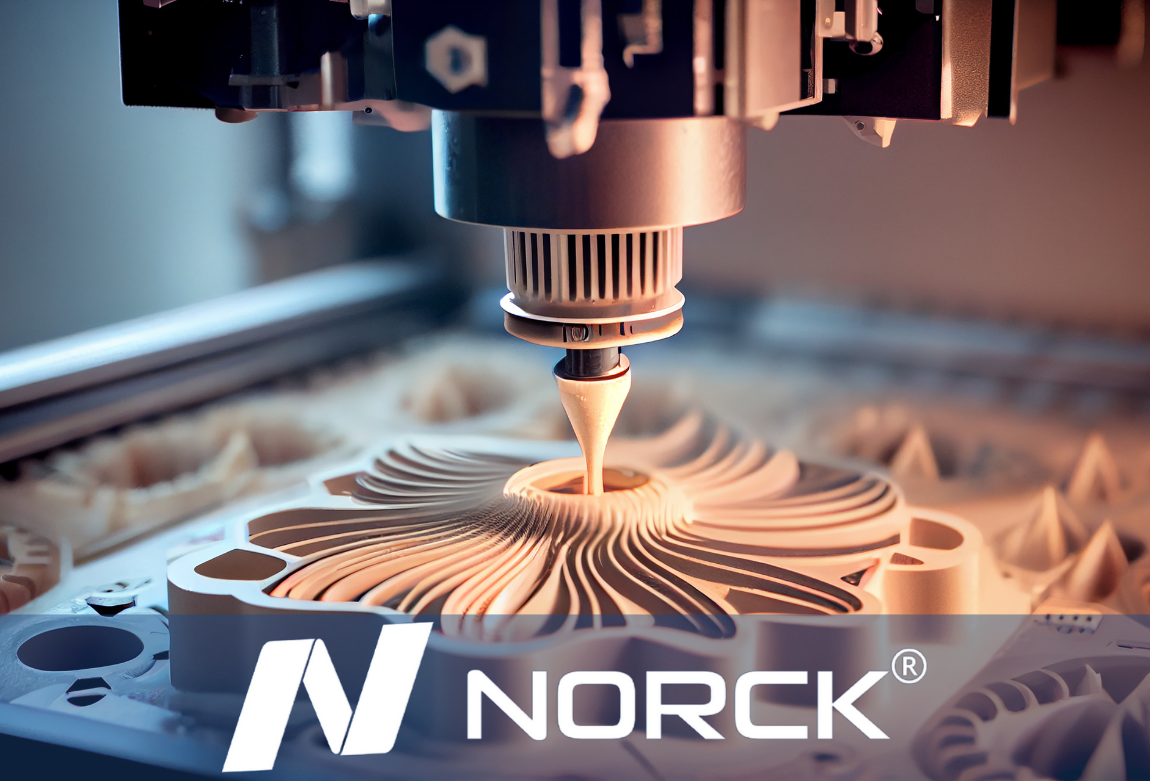

Advanced 3D printing, CNC machining, grinding, and honing deliver complex components with tolerances down to ±0.001 mm.
IRVINE, CA, UNITED STATES, October 9, 2026 /EINPresswire.com/ — Norck, the German-American engineering-led manufacturing company, today announced its Concurrent Hybrid Manufacturing Protocol (CHMP), an integrated engineering approach combining advanced additive manufacturing with precision CNC machining and finishing processes.
The approach addresses a persistent challenge in industrial manufacturing: producing complex components with internal geometries that conventional machining cannot easily reach while maintaining extremely tight dimensional tolerances on critical functional surfaces.
By planning additive manufacturing, CNC machining, precision grinding, honing and inspection together from the initial design review, Norck aims to reduce manufacturing constraints, improve production efficiency and expand design possibilities for aerospace, robotics, medical technology and industrial equipment manufacturers.
For qualifying applications, selected precision-machined features can achieve tolerances as tight as ±0.001 mm (±1 micron), subject to material, geometry and inspection requirements.
Solving Manufacturing Challenges Beyond Conventional Methods
Modern industrial components increasingly combine lightweight structures, intricate internal channels and precision mechanical interfaces.
Traditional CNC machining delivers dimensional accuracy but faces limitations when producing inaccessible internal features. Industrial 3D printing offers greater geometric freedom, yet printed surfaces may require additional finishing to achieve demanding functional tolerances.
Norck’s Concurrent Hybrid Manufacturing Protocol addresses these limitations by assigning each feature to the manufacturing process best suited to its requirements.
Metal additive manufacturing creates complex near-net-shape geometries, while custom cnc milling services, turning, grinding and honing establish precision bores, sealing surfaces, threads and mating interfaces.
This integrated approach enables the production of custom cnc machined parts, custom metal components and custom steel parts that combine geometric complexity with application-specific dimensional accuracy.
The ±0.001 mm tolerance applies only to qualifying finished features, not to the overall accuracy of an additively manufactured component.
Engineering Additive Manufacturing and CNC Precision Together
Unlike sequential production methods, Norck’s protocol coordinates additive manufacturing and precision machining requirements before manufacturing begins.
Through its 3d printing design Service and engineering evaluation process, Norck assesses component geometry, material selection, build orientation, machining allowances, datum locations and inspection accessibility.
Its 3d printing development capabilities support design optimization, functional validation and manufacturing process selection for complex industrial applications.
The objective is to identify potential production limitations before they result in redesign, excessive material waste or additional manufacturing operations.
Norck also provides custom components and Custom made parts through integrated engineering and manufacturing services, allowing customers to select production methods based on functional requirements rather than process limitations.
Advanced 3D Printing Technologies for Industrial Applications
Although the hybrid protocol primarily targets demanding metal components, Norck’s broader additive manufacturing capabilities support a wide range of industrial materials and applications.
Direct Metal Laser Sintering (DMLS) enables the production of complex metal geometries, including internal fluid channels, lightweight structures and consolidated mechanical assemblies.
For polymer applications, Norck offers carbon dls 3d printing, supporting intricate geometries and functional components using application-specific photopolymer materials.
Its FDM 3D Printing Services support engineering prototypes, manufacturing fixtures, assembly aids and functional thermoplastic parts.
Additional Plastic 3D Printing capabilities and 3d plastic printing services provide options for lightweight components, customized housings and specialized industrial applications.
Through its online 3d printing service, Norck connects digital manufacturing access with engineering support, helping customers evaluate the most suitable process for their technical requirements.
From Prototype Development to High-Volume Manufacturing
Norck’s engineering-led manufacturing model extends beyond initial prototyping.
Customers can move from concept validation and functional prototypes to repeat production, with manufacturing processes evaluated according to material requirements, component complexity, production volume and cost efficiency.
For High-Volume Manufacturing, Norck assesses whether hybrid manufacturing, conventional CNC machining, casting, injection molding or alternative production methods provide the most appropriate long-term solution.
This process-focused approach allows manufacturers to balance design flexibility, dimensional accuracy and production economics throughout the component lifecycle.
Industrial Applications and Proven Engineering Experience
Potential applications for concurrent hybrid manufacturing include aerospace housings, hydraulic manifolds with internal channels, precision robotics components, lightweight mechanical structures and industrial equipment requiring complex geometries with accurately finished interfaces.
Norck’s broader precision manufacturing experience includes projects supporting aerospace and hydrogen technology development.
Norwegian manufacturer Stamas Solutions AS worked with Norck on critical components for a high-precision aerospace project involving the University of Stavanger. Pål Svanes, CEO of Stamas Solutions, highlighted the importance of reliable manufacturing quality and timely delivery.
In France, hydrogen technology company H2 Pulse used Norck-manufactured components for hydrogen system sample testing. Vivien Gatard, PhD, Engineer for Hydrogen Systems at H2 Pulse, praised Norck’s engineering services.
These projects demonstrate Norck’s experience supporting demanding engineering applications, although they are not presented as independently verified case studies of the newly announced hybrid protocol.
Executive Perspective: Engineering Beyond Conventional Limits
“The most challenging components are often the ones conventional manufacturing was never designed to produce,” said Mucahit Basaran, CEO of Norck.
“Our engineers evaluate which features should be additively manufactured and which require precision machining, grinding or honing. By bringing these decisions together early in development, we can help transform complex designs into functional industrial components without allowing conventional manufacturing limitations to dictate the entire design.”
What Is Concurrent Hybrid Manufacturing?
Concurrent hybrid manufacturing is an engineering approach in which additive manufacturing and precision machining are planned together from the initial design stage.
Rather than manufacturing a component through isolated production steps, engineers evaluate geometry, material behavior, machining accessibility and inspection requirements as part of one coordinated process.
The approach can support complex internal structures while maintaining tight dimensional tolerances on selected functional surfaces.
For engineers developing demanding industrial components, the objective is straightforward: use the most appropriate manufacturing technology for each feature without compromising the overall component design.
About Norck
Norck is a German-American engineering-led manufacturing company operating in Germany and the United States.
The company provides on-demand precision CNC machining, industrial 3D printing, sheet metal fabrication, injection molding, precision grinding, honing and custom component manufacturing.
Supported by engineering expertise and design-for-manufacturability services, Norck serves customers across aerospace, automotive, robotics, medical devices, energy, electronics and industrial automation.
Norck’s manufacturing portfolio supports projects from initial design and prototyping through production. The broader brand portfolio includes Baucor, Bauron and Norck Robotics.
Rabia KOCA
Norck
Visit us on social media:
LinkedIn
Legal Disclaimer:
EIN Presswire provides this news content “as is” without warranty of any kind. We do not accept any responsibility or liability
for the accuracy, content, images, videos, licenses, completeness, legality, or reliability of the information contained in this
article. If you have any complaints or copyright issues related to this article, kindly contact the author above.

Media gallery